HTML Context Menu

The HTMLContextMenu template is for designing context menus for the repository explorer on the web.
(relevant from version 10.2, and enhanced in version 10.3)

The symbols available for HTMLContextMenu are:
HTMLContextMenuItem

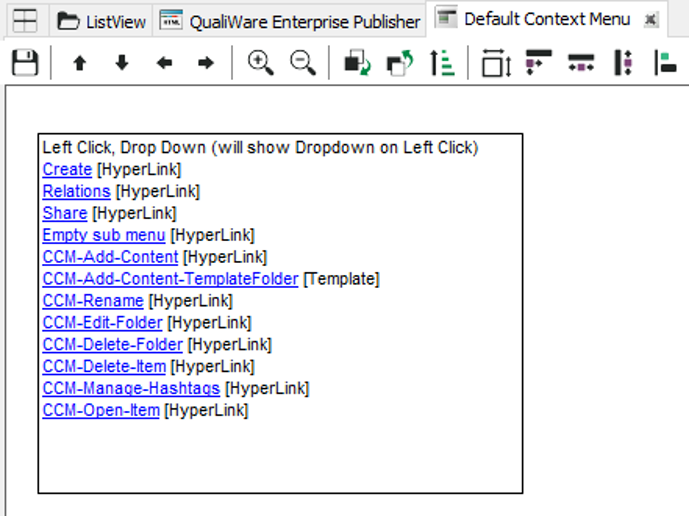
The graphical part of HTMLContextMenu is only used to define context menus; it is not used for displaying to the user. The HTMLContextMenuItems on the HTMLContextMenu are defining when and where context menus are available to the user.

Example of HTMLContextMenu:
A default context menu can be defined in the HTMLPublisher. The default context menu will be applied to objects of all templates unless specific context menu is defined on the HTMLTemplateDefinition for the template. If the default context menu is left empty then only templates with a context menu defined will get a context menu.

A default context menu defined on the HTMLPublisher:

A template specific context menu is defined on the template definition for that template:

To activate the changes in context menu setup press publish in the HTMLPublisher.

Context menu and Governance Workflow Engine
Objects governed by a GovernanceWorkflow will get an extra context menu item. The item is called Governance and is added as the last item of the context menu. It contains the possible transitions available for the object.
HTML Context Menu Item

HTMLContextMenuItem are used in a HTMLContextMenu to create a ContextMenu in the Repository Explorer.

Settings for the HTMLContextMenuItem
(relevant from version 10.2)

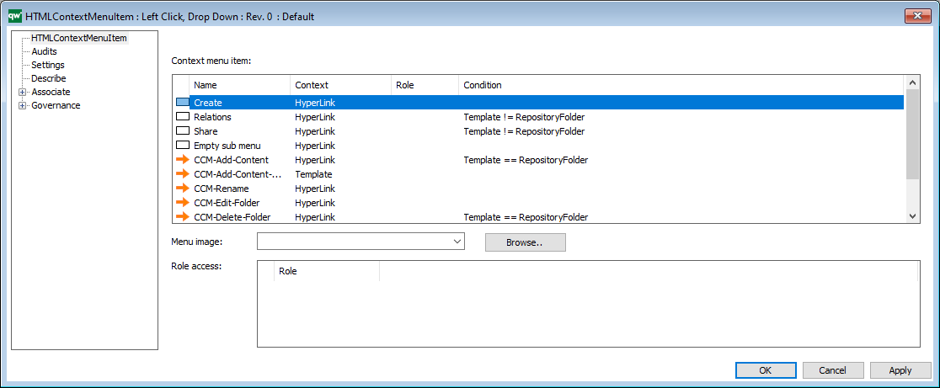
HTMLContextMenuItem sample:

Context menu item: List of items to who in the context menu

Menu Image: Not supported

Role access: General role access for all items in the context menu.

Context menu items:

The context menu supports GovernanceStateFeature and HTMLContextMenuItem. Adding a GovernanceStateFeature means adding an action to the context menu. Adding a HTMLContextMenuItem will create a sub menu in the context menu.

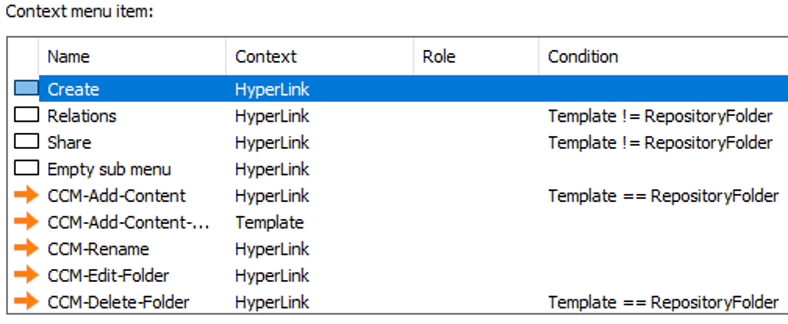
  • Context
    • The context defines where the context menu should be activated from. HyperLink means the menu will be available on objects in the repository explorer. Template means the context menu will be available when a template name is shown in the treeview part of the repository explorer. (Toolbar is not supported)
  • Role
    • Ability to select role-based access to the menu item.
  • Condition
    • Additional condition for showing the menu item. E.g. Template == RepositoryFolder


Sample list of context menu items containing one sub menu and several items with conditions set:

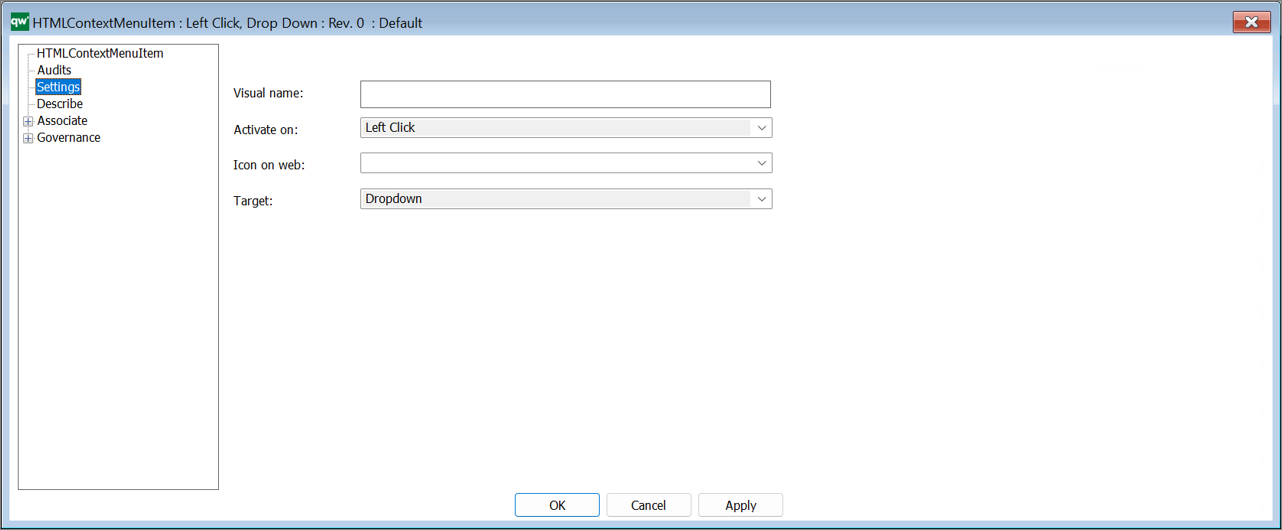
Settings tab on HTMLContextMenuItem

The settings defined on this tab will apply to the whole context menu. If a HTMLContextMenuItem is used as a sub menu, then only Visual name is used.

Visual name

  • Used to define the display name when used as a sub menu

Active on

  • Currently only Left Click is supported

Icon on web

  • Not used here.

Target

  • Only Dropdown supported.

Service Level Expectation

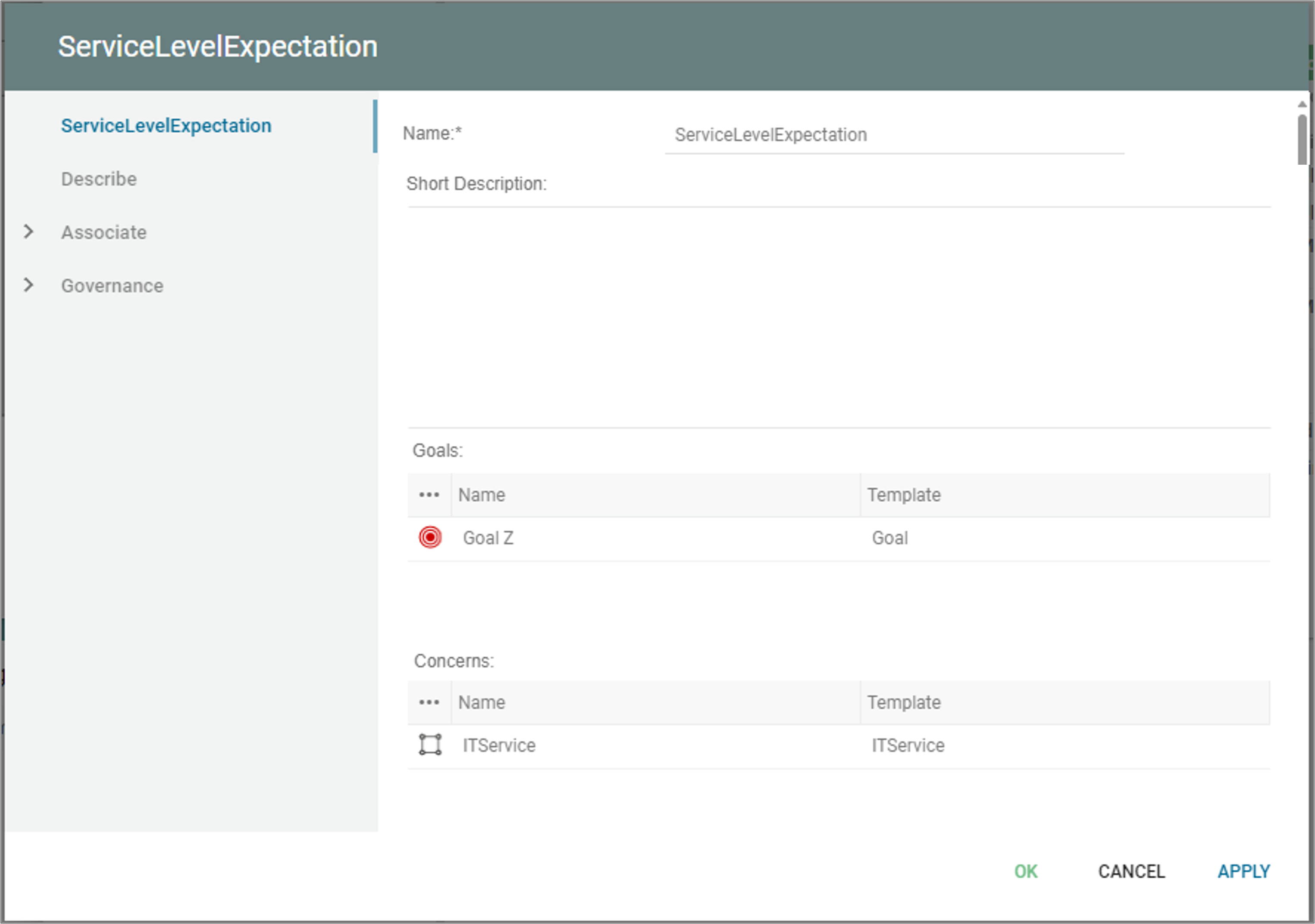
This object is used to describe Service Level Expectations, and contain the following standard propertity fields.

The object can be associated to Goals, and can linked to an IT-Service (Concerns).

Service Level Agreement

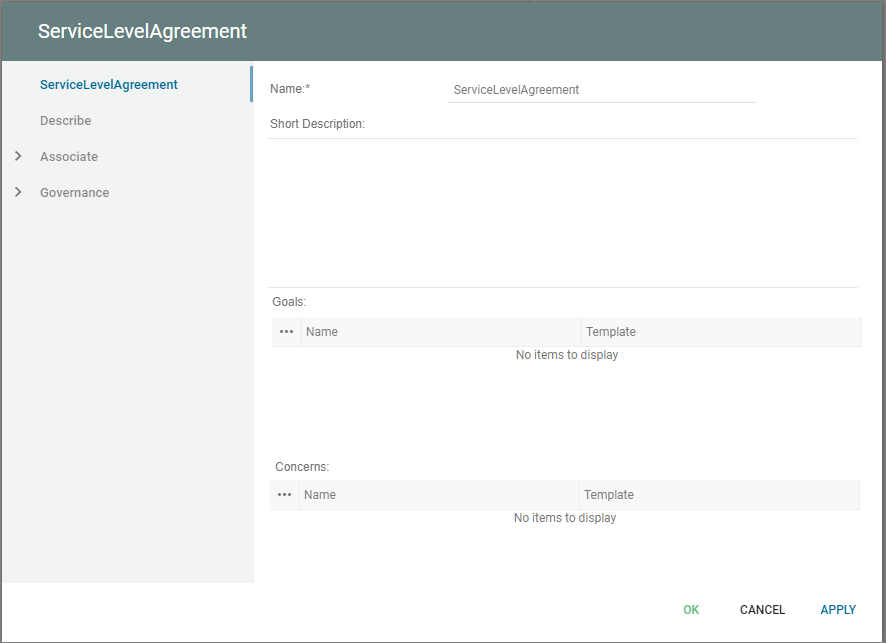
This object is used to describe Service Level Agreements (SLAs), and contain the following standard propertity fields.

The SLA can be associated to Goals, and can linked to an IT-Service (Concerns).

Work Operation

In a manufacturing routing network, the symbol “Work Operation” represents a specific step or task in the manufacturing process that is required to produce a particular product. This symbol is typically used to show the detailed sequence of operations that are involved in creating a product, from raw materials to finished goods. A work operation can represent a wide variety of activities, such as assembly, machining, inspection, testing, or packaging, and is often associated with a specific machine, tool, or piece of equipment. Overall, the Work Operation symbol is a critical component of a manufacturing routing network, as it helps to ensure that the manufacturing process is well-organized, efficient, and can be easily understood by all stakeholders involved in the process.

Work Center

A workcenter can be a part of a Production Site, used to graphically contain production assets such as ProductionLines, Equipments, FixedInstallations.

Additionally it is possible to describe the workcenter from a economic point of view.

Wire

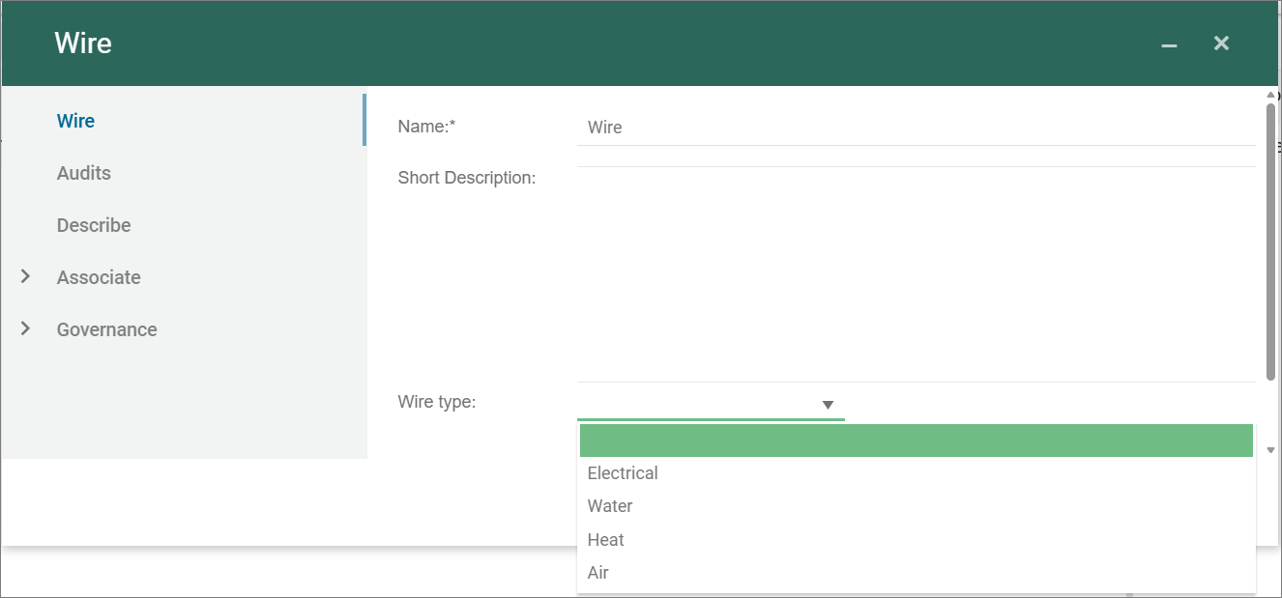
The Wire can be used to model connetions between components. It is possible to select between different types of wire, e.g. Electrical, Water, Heat or Air.

Weakness

A weakness refers to a negative aspect of a process, workflow, or journey that hinders its success. It is a characteristic or attribute that creates obstacles and challenges that need to be addressed. For example, in a customer journey map, a weakness might refer to the poor navigation of a website or the long wait times for customer service. In a process map, a weakness might refer to the inefficiency or unreliability of a particular stage in the process.