Description of this template will be available soon.
Archives: Templates
Templates and model types in the QualiWare platform.
Project Contribution
Project contribution refers to the participation and contribution of different stakeholders or components within a project. It represents the roles and responsibilities of each stakeholder or component and their contribution to the overall success of the project.
Lines may be used to connect the goal of increasing customer satisfaction with the initiative to offer discounts to loyal customers, to represent how this initiative contributes to the achievement of the goal.
Project
The “Project” symbol typically represents a discrete initiative or effort that has a defined scope, budget, and timeline.
The Project symbol can be used to represent a wide variety of different types of projects, such as new product development, process improvement, IT system implementation, or organizational change. It can also be used to represent projects at different levels of scale, from small, departmental-level initiatives to large, enterprise-wide programs.
Profile Application
A ProfileApplication is a template in a Class Diagram that represents the relationship between a model and a profile, indicating that the profile is being applied to the model. This relationship enables the usage of domain-specific stereotypes, tagged values, and constraints defined in the profile to customize or adapt the model according to the specific domain or context requirements.
By applying a profile to a model, you can introduce domain-specific semantics and rules to the elements in the model, making it more expressive and tailored to the particular application or industry.
Example: In a Class Diagram for a system that manages a healthcare facility, you might have a model called “HealthcareSystem” and a profile called “HealthcareDomain”. The “HealthcareDomain” profile includes stereotypes such as “Patient”, “Doctor”, “Nurse”, and “MedicalRecord”, as well as tagged values and constraints relevant to the healthcare domain.
To apply the “HealthcareDomain” profile to the “HealthcareSystem” model, you would create a ProfileApplication relationship between them. By doing this, you enable the usage of the domain-specific stereotypes, tagged values, and constraints defined in the “HealthcareDomain” profile to customize the elements in the “HealthcareSystem” model, making it more expressive and suited to the healthcare domain.
Profile
A Profile is a template in a Class Diagram that serves as an extension mechanism for customizing or adapting a base modeling language, such as UML, to a specific domain or context. Profiles allow you to define domain-specific stereotypes, tagged values, and constraints that can be applied to the elements in your model, providing additional information or semantics relevant to your specific application or industry.
In a Class Diagram, a Profile is a collection of stereotypes, tagged values, and constraints organized in a separate package or namespace. These elements can be applied to classes, attributes, operations, and other elements in your model to refine their meanings or behaviors based on your specific domain requirements.
Example: In a Class Diagram for a system that manages a healthcare facility, you might create a Profile called “HealthcareDomain” that includes stereotypes such as “Patient”, “Doctor”, “Nurse”, and “MedicalRecord”. These stereotypes can be applied to classes in your model to provide domain-specific context and semantics. For instance, you could apply the “Patient” stereotype to a class called “Person” to indicate that the class represents a patient in the healthcare domain. Additionally, you could define tagged values and constraints within the Profile to further customize the behavior and properties of the elements in your model, such as specifying the valid range of values for a patient’s age or the format of a medical record number.
Product Rule
Description of this template will be available soon.
Product Operation
Description of this template will be available soon.
Production Line
In a Manufacturing Routing Network, the symbol of a production line represents a sequence of workstations, machines, and other resources, arranged in a linear fashion, to perform a specific manufacturing process or produce a particular product.
Each workstation or machine in the production line performs a specific operation or task, and the work-in-progress moves from one station to the next until it is completed.
Product Interface
Interface between two products.
Product Demand
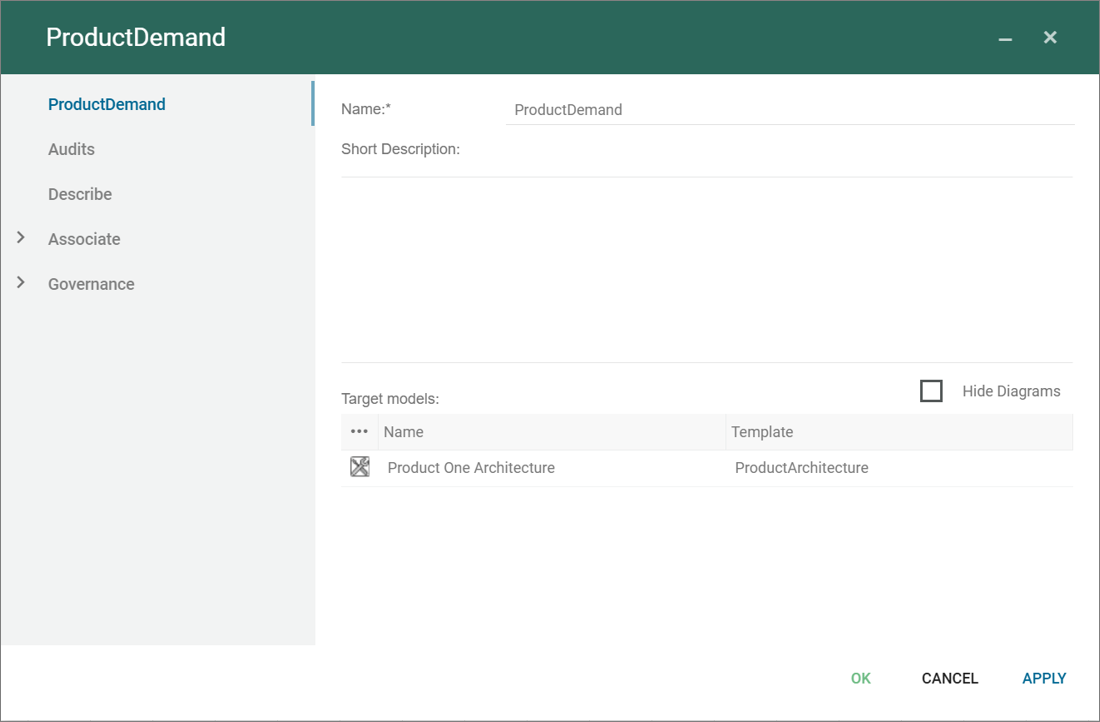
Product Demand can be used to describe a demand for a product and can be used in e.g. a Product Canvas.