Organization Viewpoint : Archimate

Concerns: Identification of competencies, authority, and responsibilities
Purpose: Designing, deciding, informing
Scope: Single layer/Single aspect

The organization viewpoint focuses on the (internal) organization of a company, department, network of companies, or of another organizational entity. It is possible to present models in this viewpoint as nested block diagrams, but also in a more traditional way, such as organizational charts. The organization viewpoint is very useful in identifying competencies, authority, and responsibilities in an organization.

Migration Viewpoint : Archimate

Concerns: History of models
Purpose: Designing, deciding, informing
Scope: Implementation and Migration

The migration viewpoint entails models and concepts that can be used for specifying the transition from an existing architecture to a desired architecture.

Product Viewpoint : Archimate

Concerns: Product development, value offered by the products of the enterprise
Purpose: Designing, deciding
Scope: Multiple layer/Multiple aspect

The product viewpoint depicts the value that these products offer to the customers or other external parties involved and shows the composition of one or more products in terms of the constituting (business, application, or technology) services, and the associated contract(s) or other agreements. It may also be used to show the interfaces (channels) through which this product is offered, and the events associated with the product. A product viewpoint is typically used in product development to design a product by composing existing services or by identifying which new services have to be created for this product, given the value a customer expects from it. It may then serve as input for business process architects and others that need to design the processes and ICT realizing these products.

Implement Migration Viewpoint : Archimate

Concerns: Architecture vision and policies, motivation
Purpose: Deciding, informing
Scope: Multiple layer/Multiple aspect

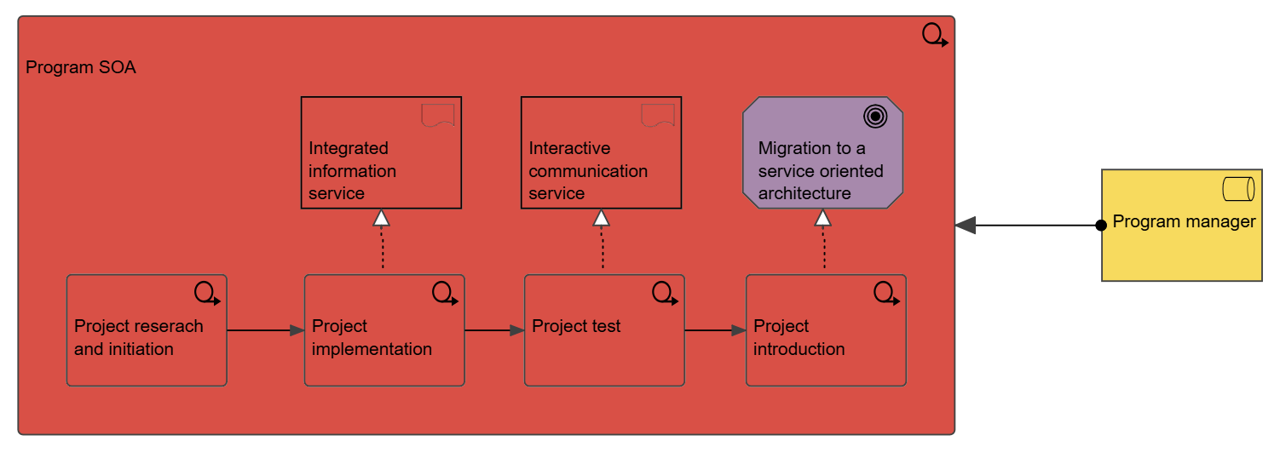
The implementation and migration viewpoint is used to relate programs and projects to the parts of the architecture that they implement. This view allows modeling of the scope of programs, projects, project activities in terms of the plateaus that are realized or the individual architecture elements that are affected. In addition, the way the elements are affected may be indicated by annotating the relationships.

Furthermore, this viewpoint can be used in combination with the programs and projects viewpoint to support portfolio management:

  • The programs and projects viewpoint is suited to relate business goals to programs and projects. For example, this makes it possible to analyze at a high level whether all business goals are covered sufficiently by the current portfolio(s).
  • The implementation and migration viewpoint is suited to relate business goals (and requirements) via programs and projects to (parts of) the architecture. For example, this makes it possible to analyze potential overlap between project activities or to analyze the consistency between project dependencies and dependencies among plateaus or architecture elements.

Application Cooperation Viewpoint : Archimate

Concerns: Relationships and dependencies between applications, orchestration/choreography of services, consistency and completeness, reduction of complexity
Purpose: Designing
Scope: Multiple layer/Multiple aspect

The application cooperation viewpoint describes the relationships between applications components in terms of the information flows between them, or in terms of the services they offer and use. This viewpoint is typically used to create an overview of the application landscape of an organization. This viewpoint is also used to express the (internal) cooperation or orchestration of services that together support the execution of a business process.

Abstraction Level
Coherence, details

Layer
Application layer

Aspects
Behavior, active structure, passive structure

Implement Deployment Viewpoint: ArchiMate

Concerns: Structure of application platforms and how they relate to supporting technology
Purpose: Designing, deciding
Scope: Multiple layer/Multiple aspect

The implementation and deployment viewpoint shows how one or more applications are realized on the infrastructure. This comprises the mapping of applications and components onto artifacts, and the mapping of the information used by these applications and components onto the underlying storage infrastructure.

Information Structure Viewpoint : Archimate

Concerns: Structure and dependencies of the used data and information, consistency and completeness
Purpose: Designing
Scope: Multiple layer/Single aspect

The information structure viewpoint is comparable to the traditional information models created in the development of almost any information system. It shows the structure of the information used in the enterprise or in a specific business process or application, in terms of data types or (object-oriented) class structures. Furthermore, it may show how the information at the business level is represented at the application level in the form of the data structures used there, and how these are then mapped onto the underlying technology infrastructure; e.g., by means of a database schema.

Service Realization Viewpoint : Archimate

Concerns: Added-value of business processes, consistency and completeness, responsibilities
Purpose: Designing, deciding
Scope: Multiple layer/Multiple aspect

The service realization viewpoint is used to show how one or more business services are realized by the underlying processes (and sometimes by application components). Thus, it forms the bridge between the business products viewpoint and the business process view. It provides a “view from the outside” on one or more business processes.


Physical Viewpoint : Archimate

Concerns: Relationships and dependencies of the physical environment and how this relates to IT infrastructure
Purpose: Designing
Scope: Multiple layer/Multiple aspect

The physical viewpoint contains equipment (one or more physical machines, tools, or instruments) that can create, use, store, move, or transform materials, how the equipment is connected via the distribution network, and what other active elements are assigned to the equipment.

Layered Viewpoint : Archimate

Concerns: Consistency, reduction of complexity, impact of change, flexibility
Purpose: Designing, deciding, informing
Scope: Multiple layer/Multiple aspect

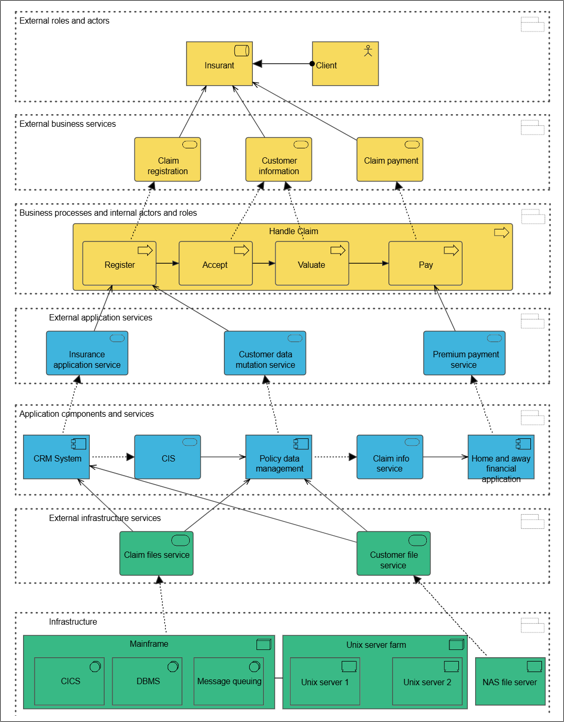
The layered viewpoint pictures several layers and aspects of an Enterprise Architecture in one diagram. There are two categories of layers, namely dedicated layers and service layers. The layers are the result of the use of the “grouping” relationship for a natural partitioning of the entire set of objects and relationships that belong to a model. The technology, application, process, and actor/role layers belong to the first category. The structural principle behind a fully layered viewpoint is that each dedicated layer exposes, by means of the “realization” relationship, a layer of services, which are further on “serving” the next dedicated layer. Thus, we can easily separate the internal structure and organization of a dedicated layer from its externally observable behavior expressed as the service layer that the dedicated layer realizes. The order, number, or nature of these layers are not fixed, but in general a (more or less) complete and natural layering of an ArchiMate model should contain the succession of layers depicted in the example given below. However, this example is by no means intended to be prescriptive. The main goal of the layered viewpoint is to provide an overview in one diagram. Furthermore, this viewpoint can be used as support for impact of change analysis and performance analysis or for extending the service portfolio.

All core elements and all relationships are permitted in this viewpoint.