In a cause and effect relationship, an action or event (which is the cause) produces an outcome or result (which is the effect).
Templates and model types in the QualiWare platform.

In a cause and effect relationship, an action or event (which is the cause) produces an outcome or result (which is the effect).
Capability configuration refers to the process of defining, organizing, and controlling the capabilities of an organization or system. Capabilities are the unique and valuable abilities that an organization or system possesses, such as the ability to produce a product, provide a service, or carry out a specific function.
The capability configuration process involves identifying the capabilities that an organization or system needs in order to achieve its goals and objectives, and then organizing these capabilities in a structured manner to ensure that they can be managed effectively.
An ability that an active structure element, such as an organization, person, or system, possesses. Capabilities focus on business outcomes. They provide a high-level view of the current and desired abilities of an organization, in relation to its strategy and its environment. They are realized by various elements (people, processes, systems, and so on) that can be described, designed, and implemented using Enterprise Architecture approaches. Capabilities may also have serving relationships, such as to denote that one capability contributes to another. Capabilities are often used for capability based planning; i.e., to describe the evolution of capabilities over time. To model such so-called capability increments, the specialization relationship can be used to denote that a certain capability increment is a specific version of that capability. The name of a capability should emphasize “what we do” rather than “how we do it”. Typically, it should be expressed as a compound noun or gerund (-ing form of verb); e.g., “Project Management”, “Market Development”, “Product Engineering”, etc.
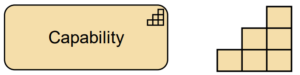
Capabilities can be described using the Capability template.
A capability can be described and rated in accordance with the business importance, current maturity and target maturity.
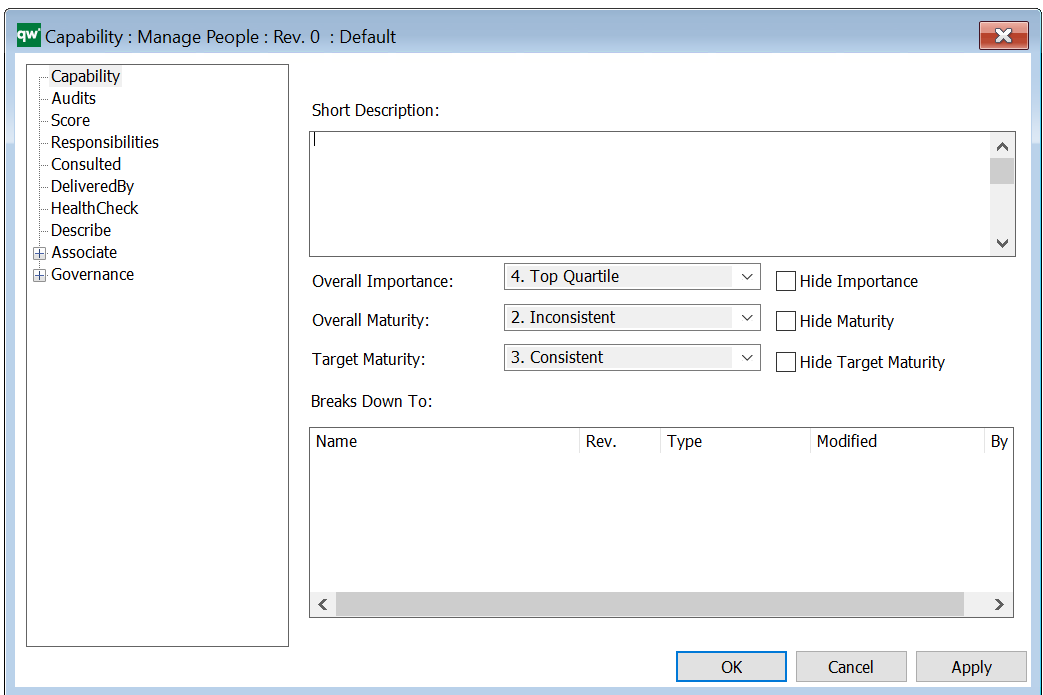
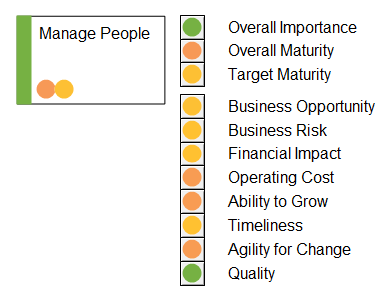
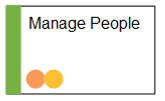
The capability rating can be illustrated on the object. The stripe on the left side represents the Business Importance and two dots represent the Business Maturity and Target Maturity.
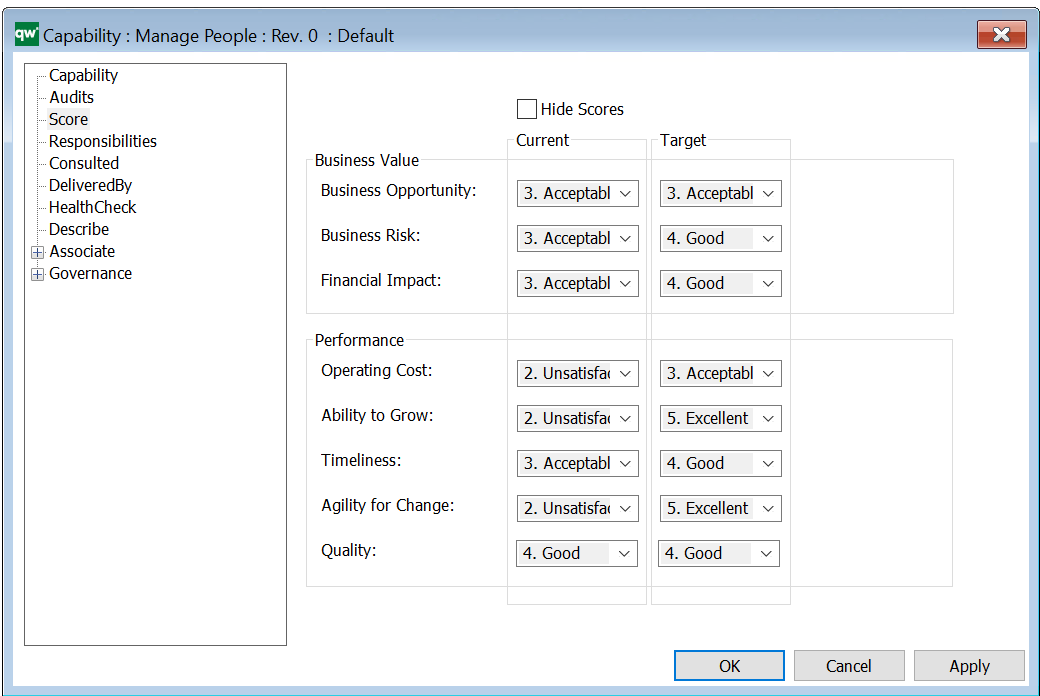
On the Score tab, additional scoring possibilities are available:
These scoring can also be shown on the object:
Capabilities are modelled in BusinessCapabilityModel-diagrams.
Calls an operation on an object, typically representing a method invocation.
Invokes another behavior (e.g., another activity or state machine) as part of the flow.
Description of this template will be available soon.
Description of this template will be available soon.
A business rule is a statement that defines or constrains some aspect of a business. It is a set of conditions or guidelines that dictate how a business should operate and make decisions. Business rules help to ensure that a business is run consistently and effectively, and that everyone involved in the business is aware of what is expected of them.
Business rules can cover a wide range of topics, including:
Description of this template will be available soon.