Field Attribute

Definition of a single layout concept for a Field.

FieldAttribute properties

The FieldAttribute tab

Property  Metamodel name Description
Value Value
Attribute type AttributeType Choices are:
Height
Width
Italic
Underline
Pitch
TrueType
Family
Face
VariableLenght
Repeatable
FieldColor
FieldDate
FieldPage
Style

Field

Field placed in a dialog in the final system.

Field properties

The Field tab

Property  Metamodel name Description
Tab-seq.no. TabSequenceNumber
Field label FieldLabel
Field Type FieldType
Related DataEntity RelatedDataEntity Links to: DataEntity.
Related Attribute RelatedAttribute Links to: Attribute.
Object Methods EventHandlers Links to: Method.
Help Line HelpLine
Help HelpItem Links to: HelpItem.

The Field Attributes tab

Property  Metamodel name Description
Field Attributes HasFieldAttribute Links to: FieldAttribute, FieldStyle.

Money Transaction

A single transfer of money

MoneyTransaction properties

The MoneyTransaction tab

Property  Metamodel name Description
Amount Amount The actual quantified amount
Account Account The finance account for this transaction
Currency Currency The currency for the transaction
Choices are:

Namespace

A namespace is an abstract container providing context for the items (names, or technical terms, or words) it holds and allowing disambiguation of items having the same name (residing in different namespaces).

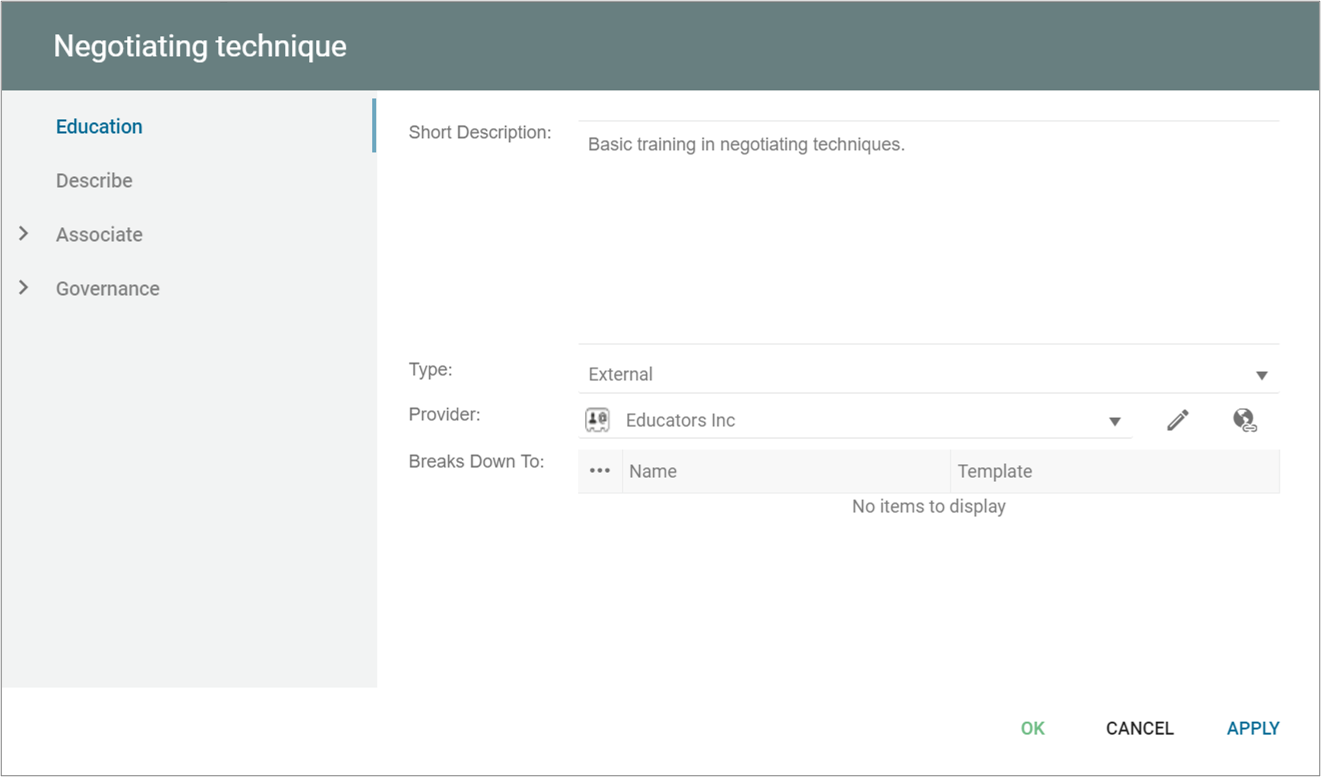
Education

Formal education or training program.

Domain

A specification of values.

Document Revision

This template is used to store references to files containing a revision of an ExternalDocument.

Data Type

In the context of a Class Diagram, a datatype is a specialized kind of classifier that represents a simple, non-composite type of data. It is used to define the types of attributes, parameters, and return values for classes and their operations. Unlike classes, datatypes typically don’t have operations or behaviors associated with them, focusing primarily on the structure of the data.

When creating a Class Diagram, you can use predefined datatypes (provided by the modeling tool or the underlying modeling language, such as UML) or define your own custom datatypes to represent specific data structures needed for your system. These custom datatypes can then be used as templates for defining the types of attributes or operation parameters and return values in your classes.

For example, consider a Class Diagram for a software system that manages books in a library. You might define a custom datatype called “ISBN” to represent the International Standard Book Number format. In this case, the “ISBN” datatype can be used as a template for the “isbn” attribute in the “Book” class. This helps ensure consistent representation and interpretation of ISBN data across the system.