The QualiWare collaboration platform is composed of desktops, a left menu and toolbar.
From the Collaboration platform the user also has easy access to:
- QualiAI, AI solution that can help you create and enrich your content
- QualiChat, AI Chatbot that allows users to ask questions, analyze content, and explore repository data in a natural, conversational way
- QualiHelp, Dynamic Help Widget that gives you easy access to help from the Center of Excellence
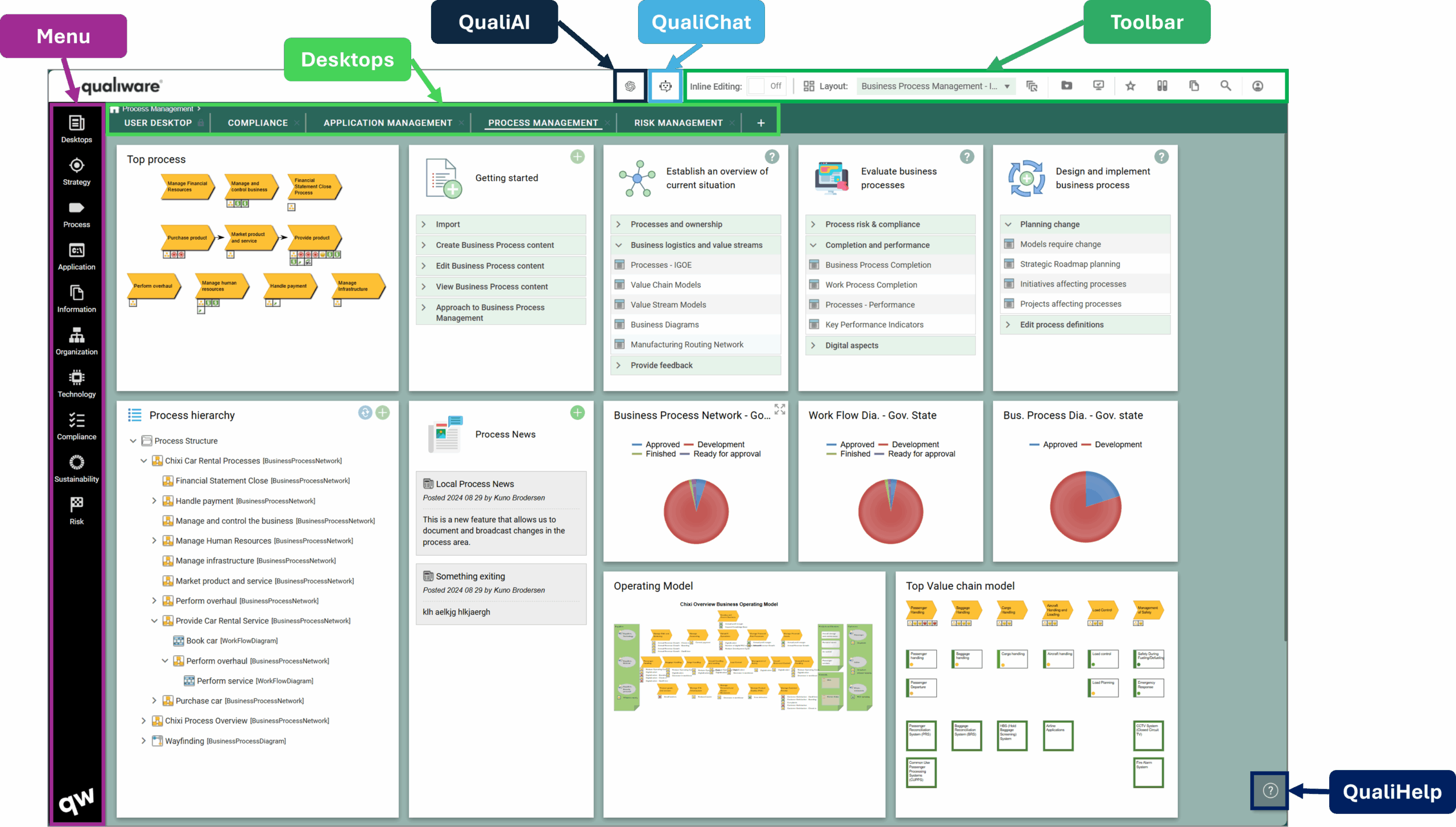
The platform is role-based, and configurable, so the relevant menus and desktops can be made available for a certain user role, and tiles are dynamically updated to user-specific content.
When a user explores a specific repository object (e.g. a diagram, change request, QualityAudit) the workspace changes to the predefined (and configurable) workspace for that particular type of object, and available governance actions are shown in the top right corner.
Collaboration Platform in QualiWare X (before version 10.10)
The collaboration platform was updated as a part of QualiWare 10.10.
Click here if you what to explore the classic collaboration platform in QualiWare X before version 10.10.
Desktop(s)
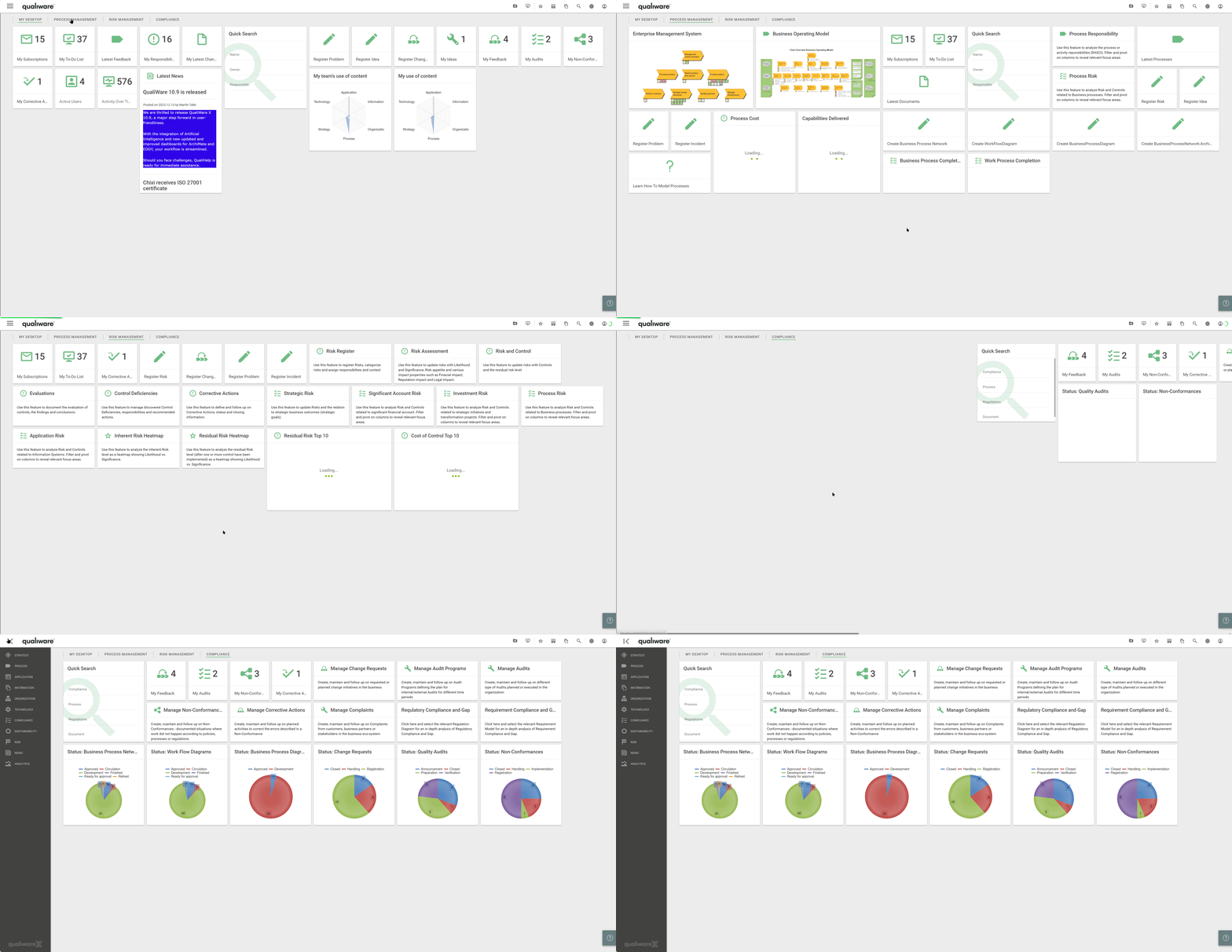
The Desktop is the starting point. Think of it as a dashboard tailored to a specific area of the business.
Each desktop is organised around a purpose — for example, Process Management, Application Management, or Compliance — and gives you a single place to explore, analyse, and work with the content in that area.
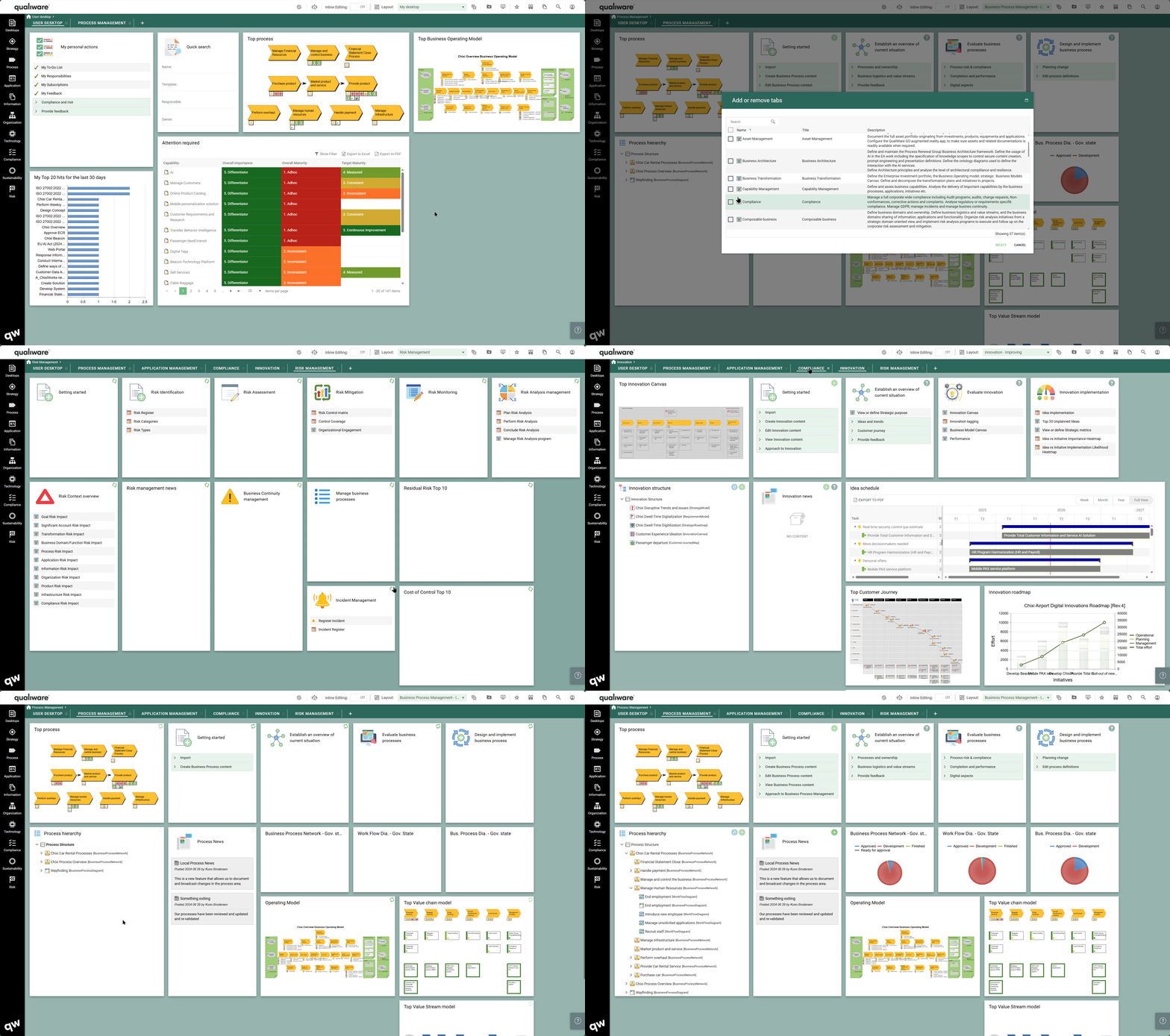
Every user has a Personal Desktop as their default starting point. It contains tiles and content that your organisation has set up for your role. From there you can navigate to any of the specialist desktops via the tabs across the top of the screen or through the left menu.
Journey based Desktops
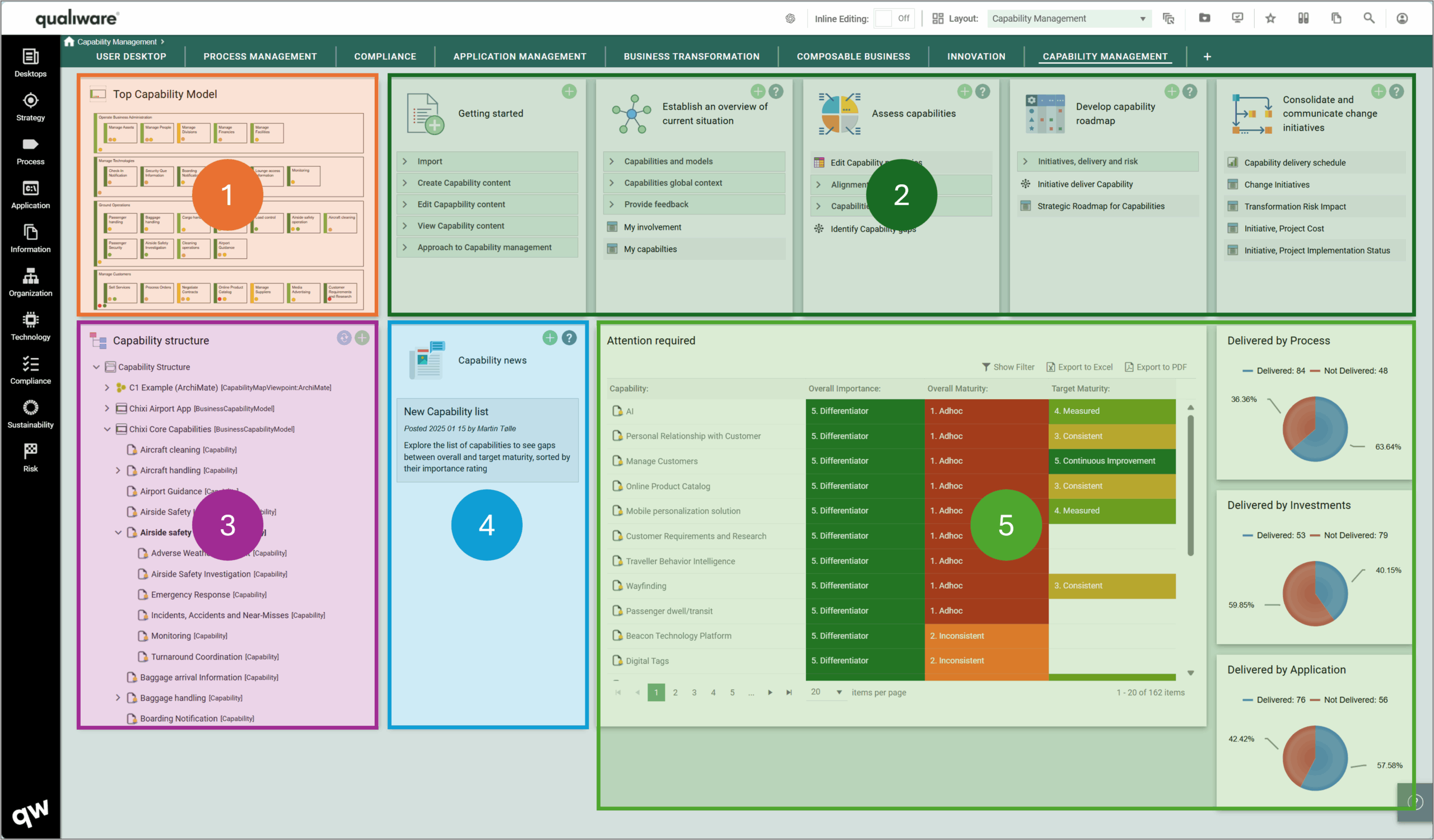
The different types of desktops are structured around the same high-level layout, allowing the users to get fast and easy access to the content and features they are looking for.
- Top Diagram for the content in the desktop (diagram and other content are presented in a (set of) workspace(s) configured for the template type)
- Purpose based tiles, that cover the whole journey within the purpose of the Desktop. The tiles support the user throughout the journey of the development and maturing of that particular area from “getting started” to browsing, modifying, and monitoring of the status. (read more here)
- Hierarchy view, collection of most relevant content within the desktop focus
- News section, a “local” desktop news feed, where users can collaborate and share relevant news
- Metrics and additional diagrams, showing KPIs, charts, and additional content
The tool contains a comprehensive set of standard desktops, each focusing on an architectural aspect, architectural framework or one or more areas within governance, risk or compliance.
Explore the list of standard Desktops here.
Personal Desktop
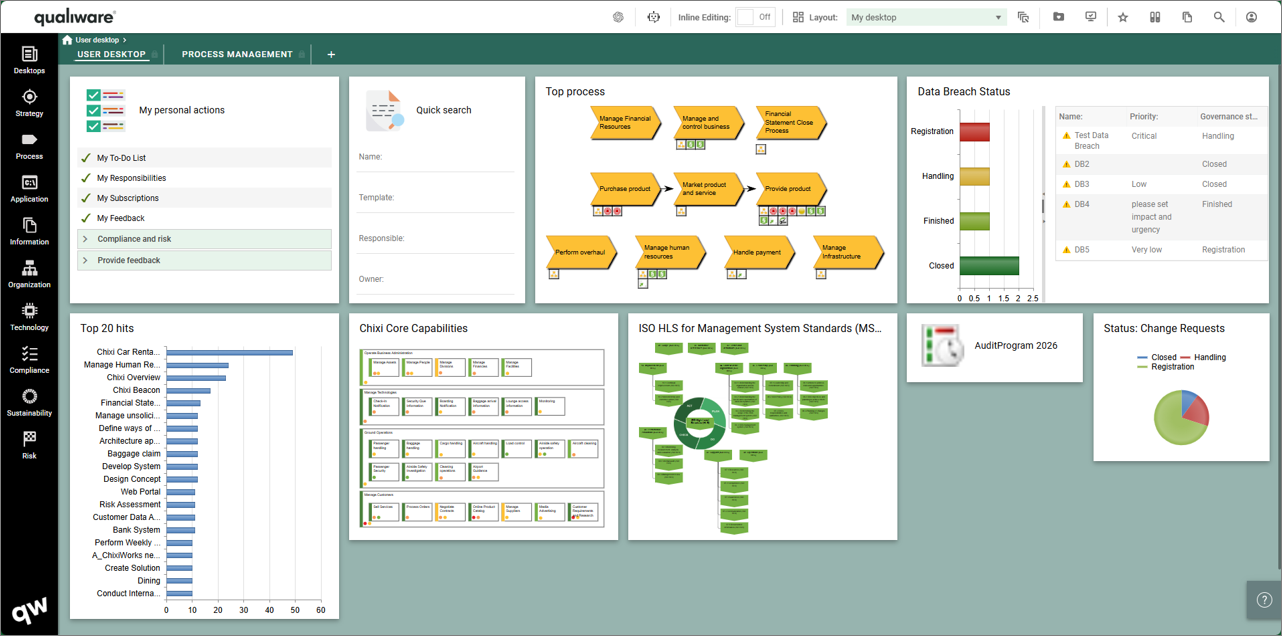
Your Personal Desktop is your home base. It starts with content your organisation has configured for your role, and you can extend it in several ways:
- Pin content — from any diagram, use the “Pin to my desktop” button in the toolbar to add it to your Personal Desktop. This is how you build a personalised view of the content most relevant to your work.
- Add tiles — from any specialist desktop, you can pin individual tiles (such as a process hierarchy or a KPI chart) to your personal desktop.
- My Personal Actions — a tile on your personal desktop that lists your To-Do items, responsibilities, subscriptions, feedback, and compliance items (audits, non-conformances, risks) all in one place.
Read more about the Desktops here.
Diagram Workspace
A workspace has a specific type of diagram or other essential (non-graphical) object in focus and contains relevant view(s) of that type of object.
Whereas a Desktop is an overview of a domain focusing on an architectural aspect, architectural framework or one or more areas within governance, risk or compliance, the diagram workspace has a diagram in the focus, and the tiles on the workspace contain content derived from the diagram/object in focus.
Workspaces are not only used to display the more than 100+ different types of diagrams available in QualiWare (explore the list here), the workspace can also be used to display non-Graphical object such as e.g. AuditProgram, QualityAudit, ChangeRequest and NonConformance.
Workspace – Multiple Layout
It is possible to create different Views for a template.
- Multiple Dashboard views
- Classic view
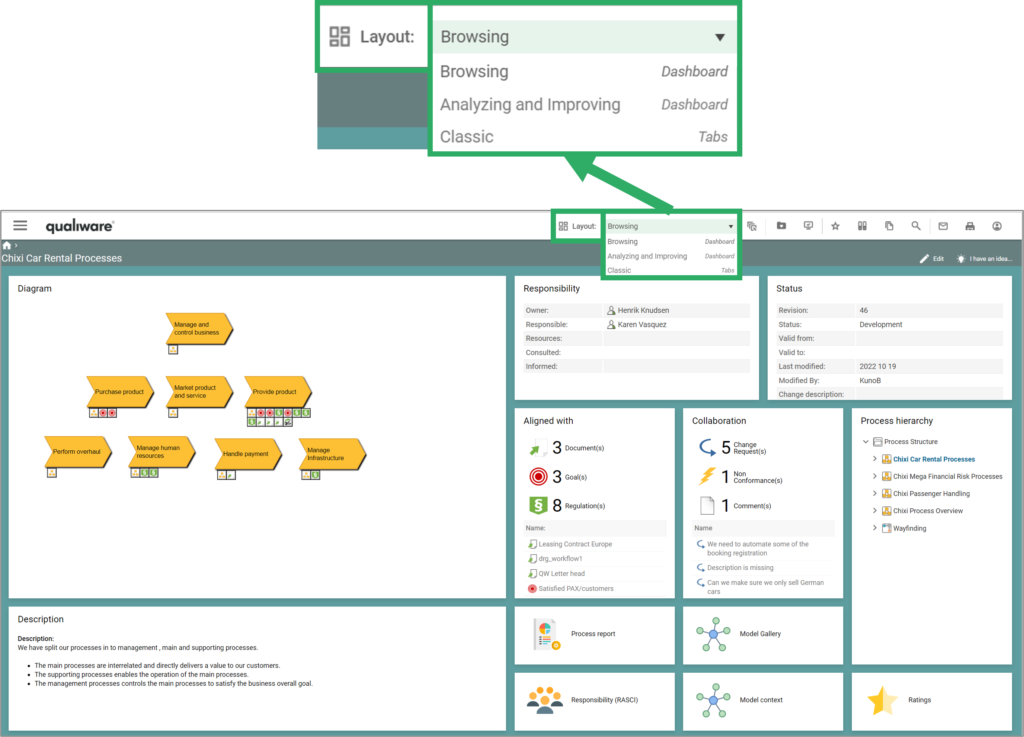
Each dashboard can have a different focus e.g. “Browsing” or “Analyze and improve”.
You can configure which layouts should be available for the different diagram/template types.
All dashboards can be configured for different users and can be role-specific, and the user can create personal customization of the dashboard by re-positioning and re-seizing tiles as well as hiding less relevant parts.
The user can select between the available layouts in the layout menu.
The “Classic” view is the classic tabular view.
Workspace – Dashboards Layouts
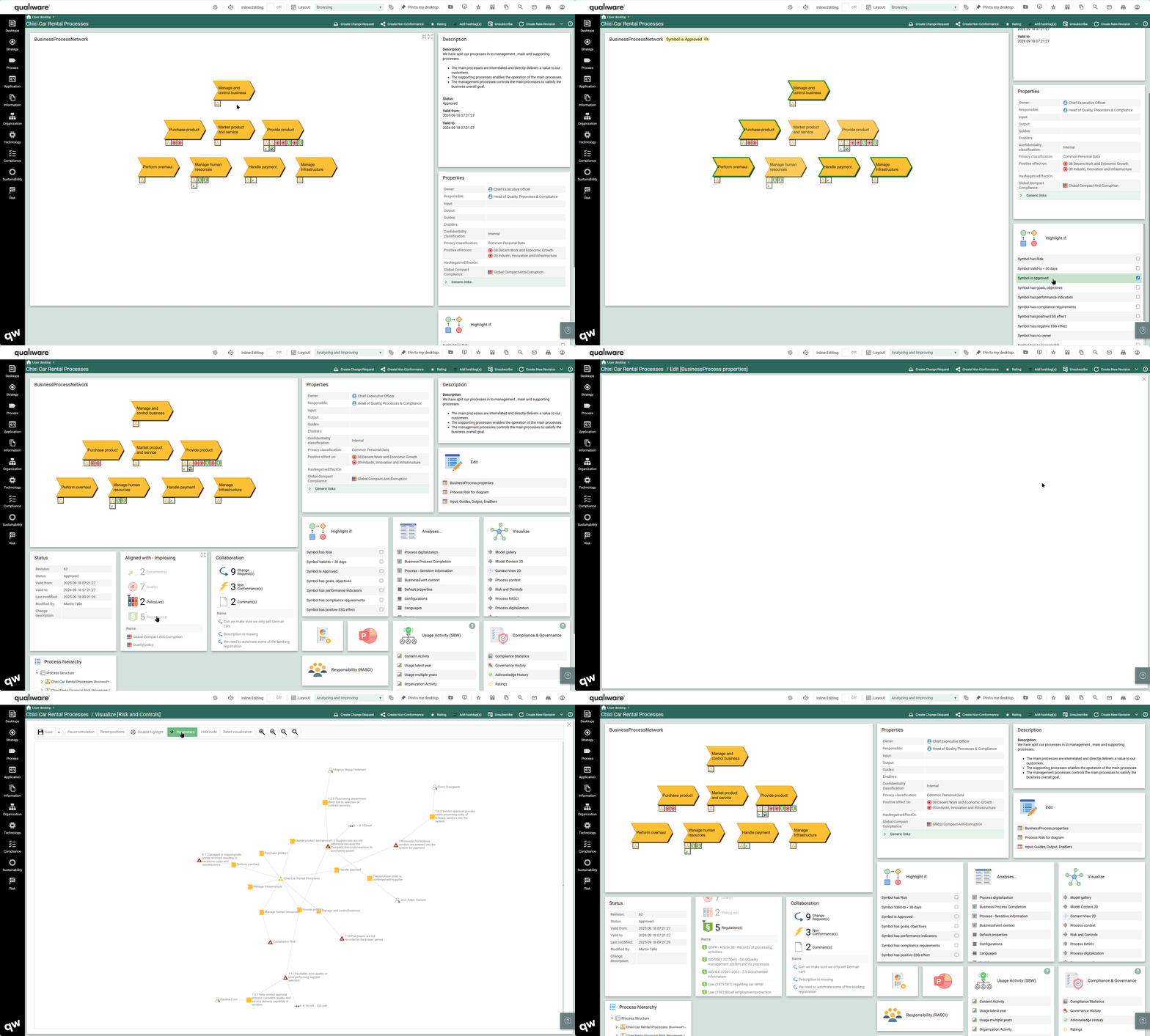
The Dashboard layout has a set of powerfull features:
- it is possible to set up multiple layouts for a diagram type
- the dashboards can be customized by the user
- the content is responsive, showing associated data either for the diagram as a whole or for the selected object
- a set of tiles have been added to provide easy access to associated features, well known as well as cool new features
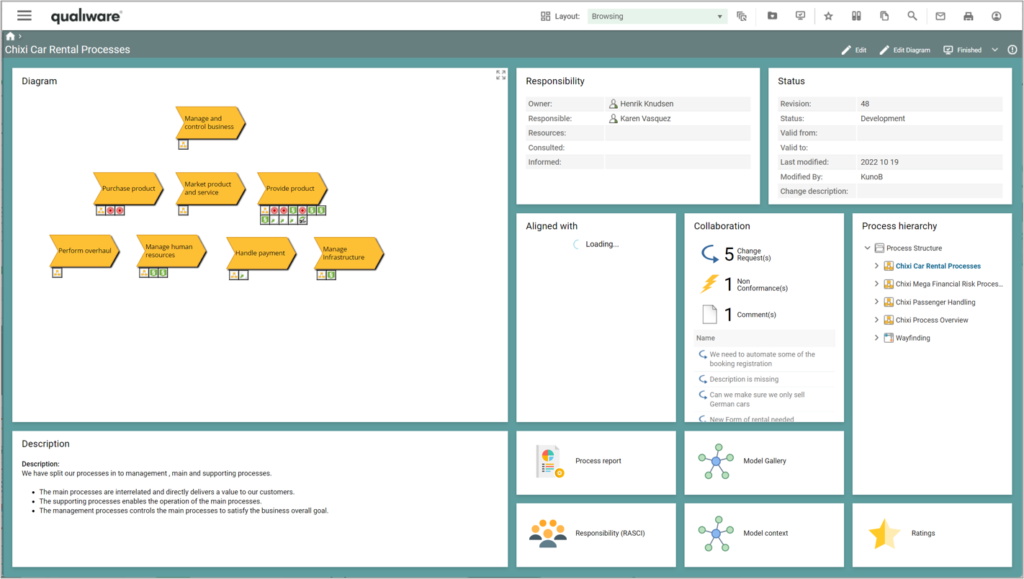
Workspace – Classic Layout
The classic workspace is a tab-based layout introduced with QualiWare X
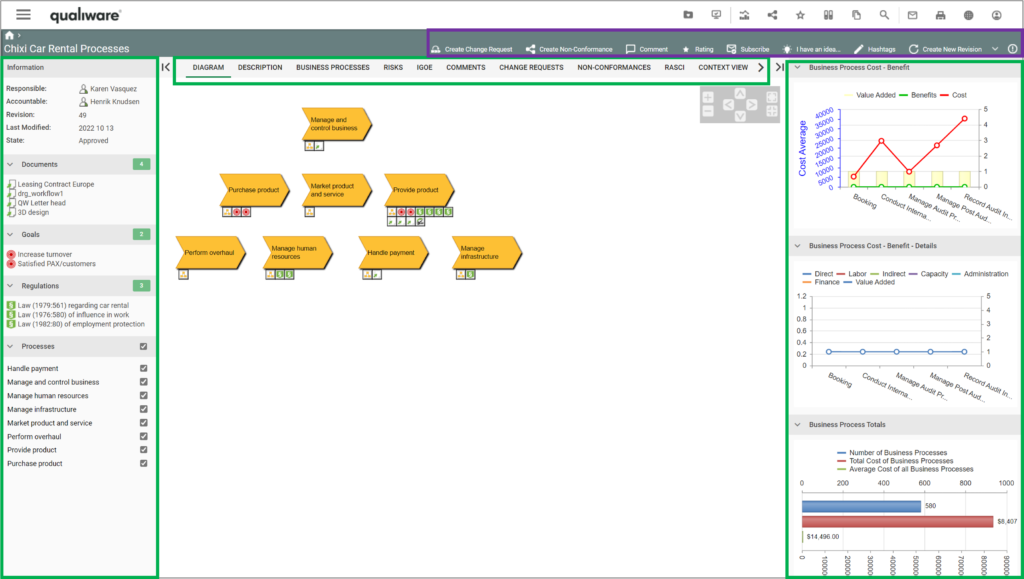
The “Classic” Diagram Workspace includes a:
- Left window (collapsible) with information about the diagram and content related to the diagram
- Center tabs with specific diagram information, analytics and editing capabilities
- Right window (collapsible) with Business information charts
All tabs and content boxes can be configured and role-based.
Governance Flows and Governance Actions
In the top right of the workspace, you can find diagram specific actions (governance actions and features). The governance actions enable the user to give input to the content (Create Change Request, Create Non-Conformance), Comment, Rate, Subscribe, Register an idea, add Hashtag, and being a content owner the user can also edit the diagram/Create a new revision of an approved diagram.

In QualiWare it is possible to set up different governance flows for different types of objects (template-types).
A governance workflow defines the governance stages and possible transitions between the stages.
For each stage, you define who has access to the available actions, e.g. who can edit the diagram or the symbol, who can approve an object, and who can create a change request associated to the object.
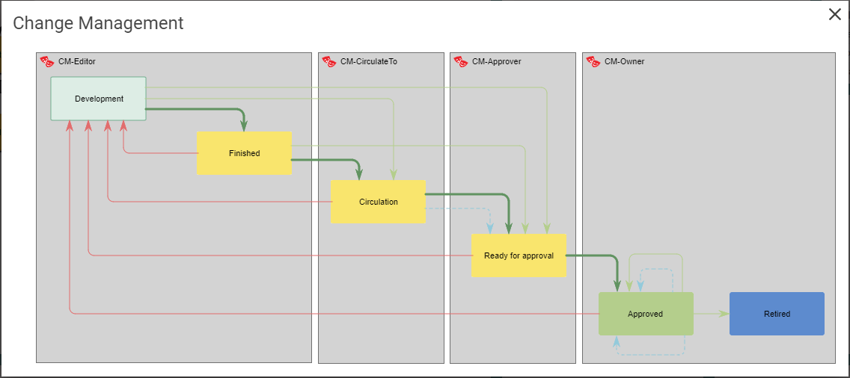
Read more about governance workflow here.
Menu
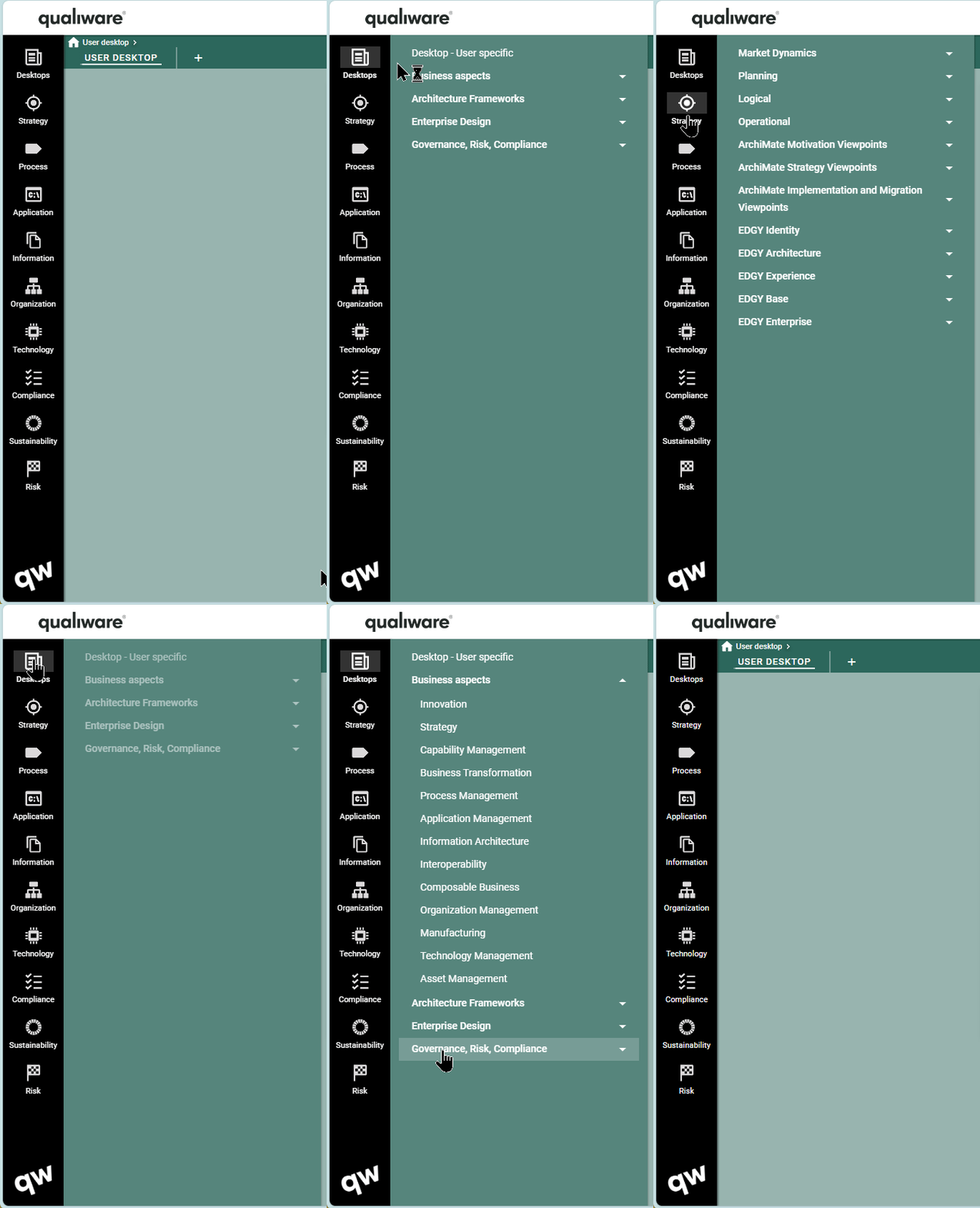
From the Menu in the left a user can access to comprehensive set of standard queries.
The standard menu is structured around the enterprise architecture dimensions, desktops and other focus areas.
As the user navigates through the menu to level two and three the menu changes into a dropdown menu.
As with everything else, the menu can be customized to contain the relevant content.
Toolbar with action buttons

The toolbar in the upper right side gives you immediate access to:
- QualiAI (if enabled)
- QualiChat (if enabled)
- Inline Editing (see more here)
- Layout
- Personal Layout (End user customization)
- your subscription, tasks and other features such as access to your latest visits, repository explorer, repository compare, repository search and your profile.
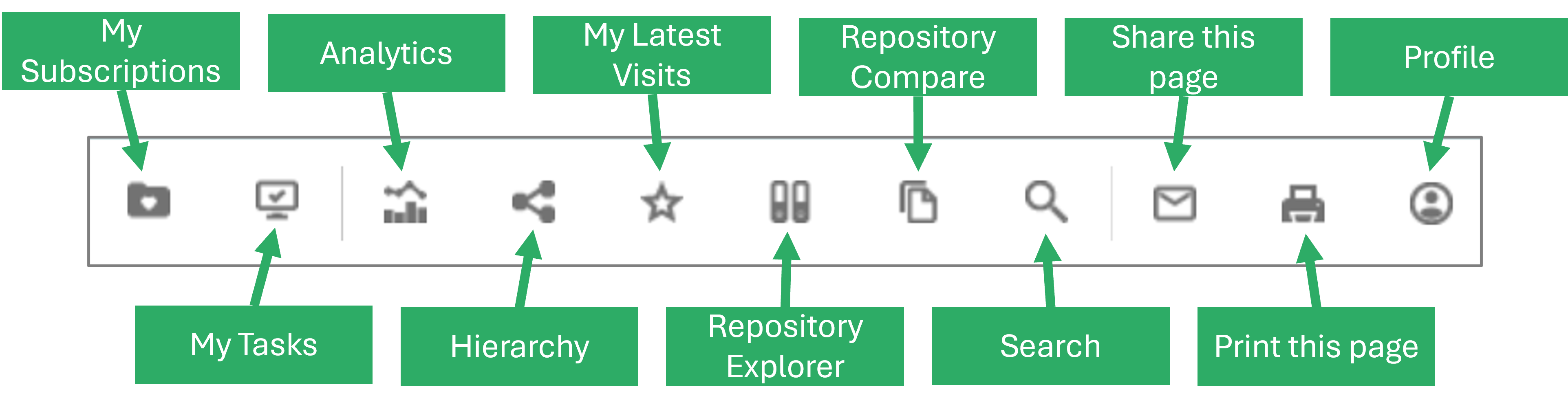
If you are viewing a specific object such as a diagram, the toolbar will contain links to the print and share functionality.
When viewing a diagram in the classic layout you can get access to analytics (Social Behaviour Data on diagrams and models) and hierarchy view in the toolbar.
When dashboard is enabled for a diagram, the toolbar will be extended with dashboard icons and features (layout and customization). On the other hand, will the icons for analytics and hierarchy not be available in the toolbar, when you are in a dashboard view, these features (hierarchy view & social behaviour chart) are/can be included as tiles in the Dashboards.

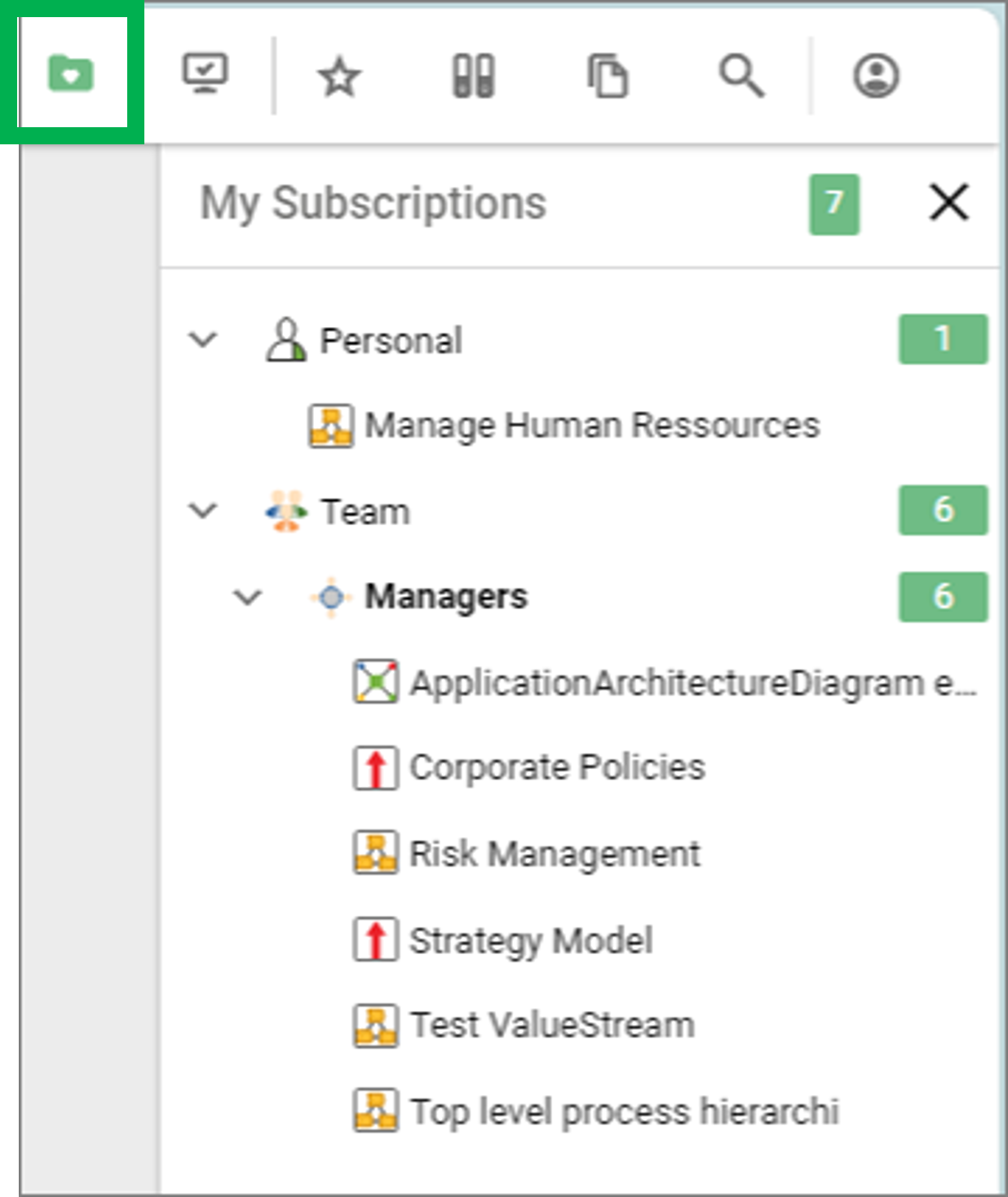
My Subscriptions
The subscriptions can be managed by the organization and/or on an individual level.
Users can subscribe to specific content. As standard the “Subscribe” action-button is part of the change management governanceworkflow for approved content (this can be configured).
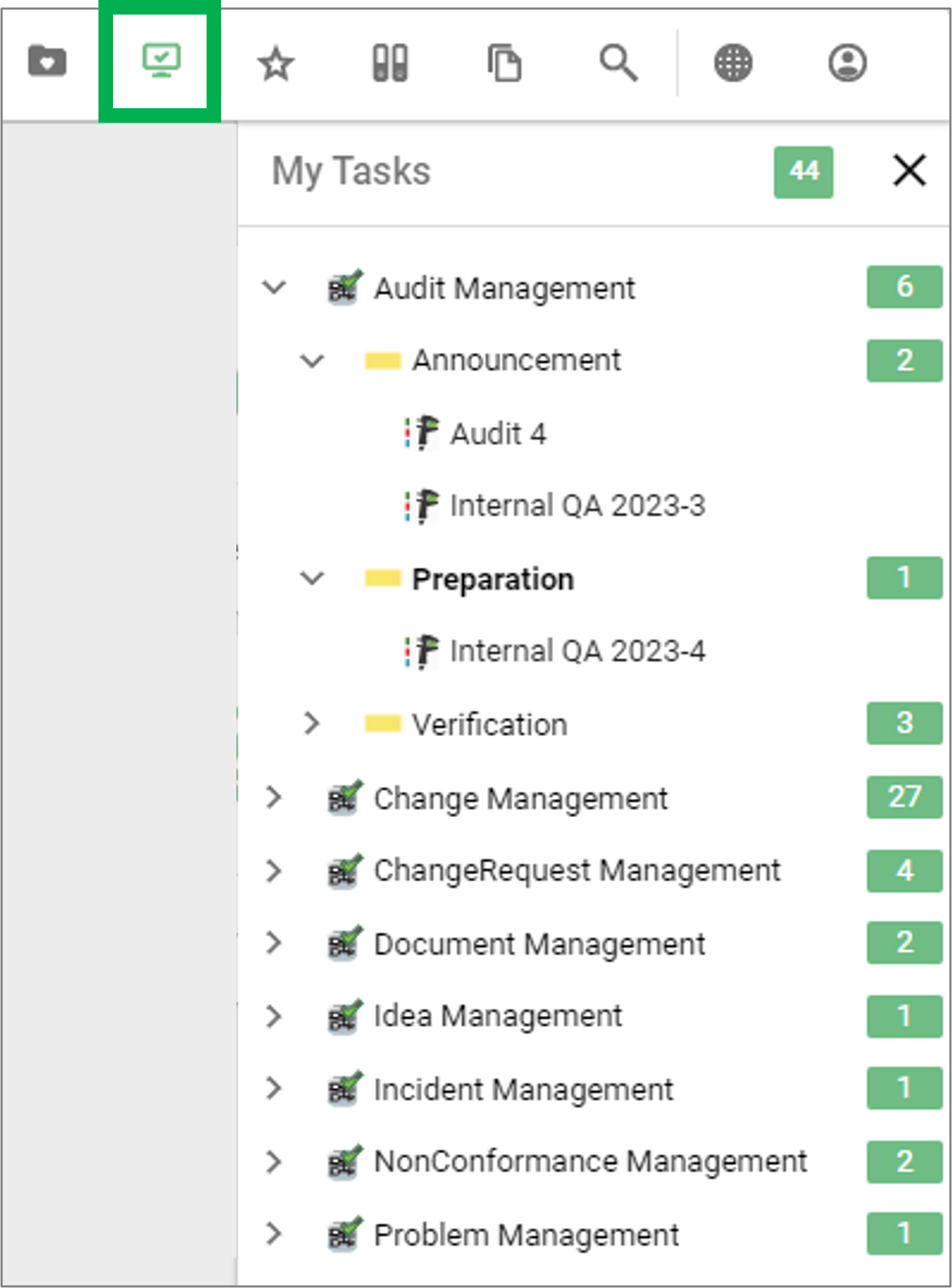
My Tasks
The tasks list is order by the underlying governanceworkflow, and the governance-states within the flow.
The task list contains the same objects as on the “To Do list” on a desktop. Whereas this list is organized by governance flow and state, the To Do list contains a description of the required actions that is associated with the governance task.
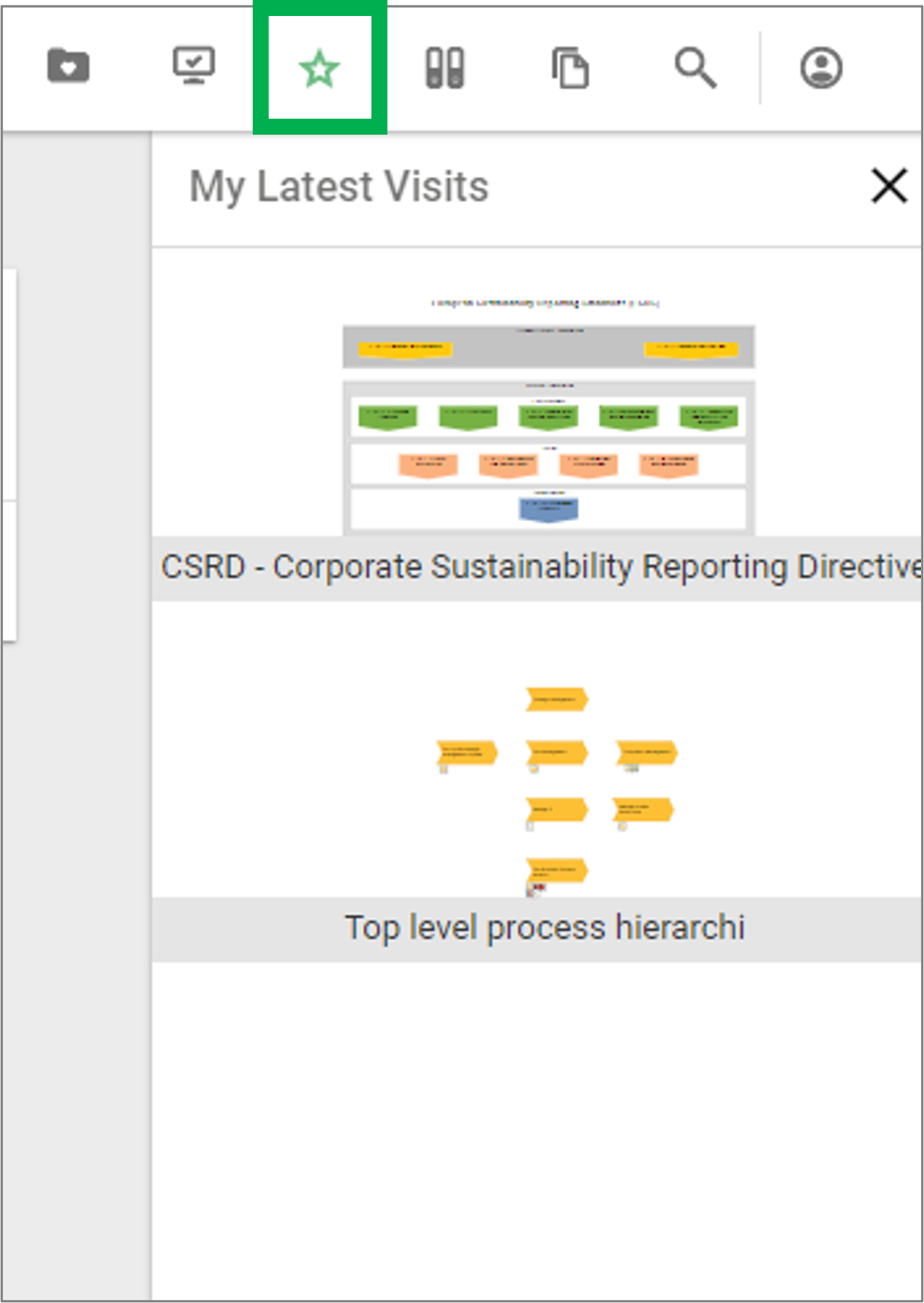
My Latest Visits shows a list of the most recent diagrams visited by the user.
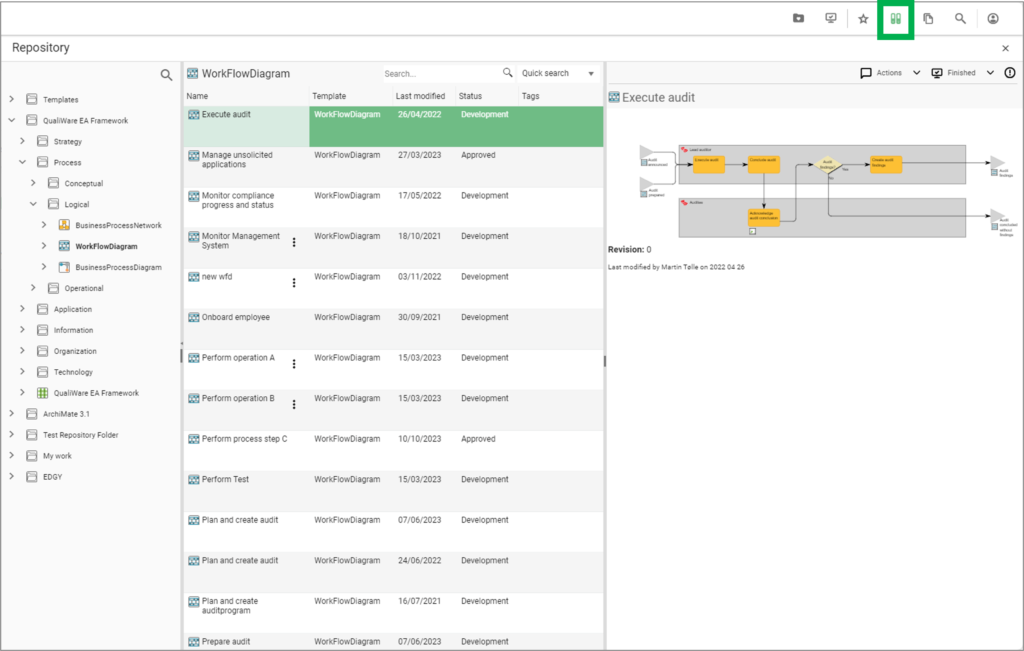
Repository Explorer
The feature enables you to explore and search content in the repository. In addition, the repository explorer provides easy access to a whole set of options from the content menu including edit, collaboration, visualizations, and explore relations to the object.
Learn more about how Repository Explorer works and how you can use it.
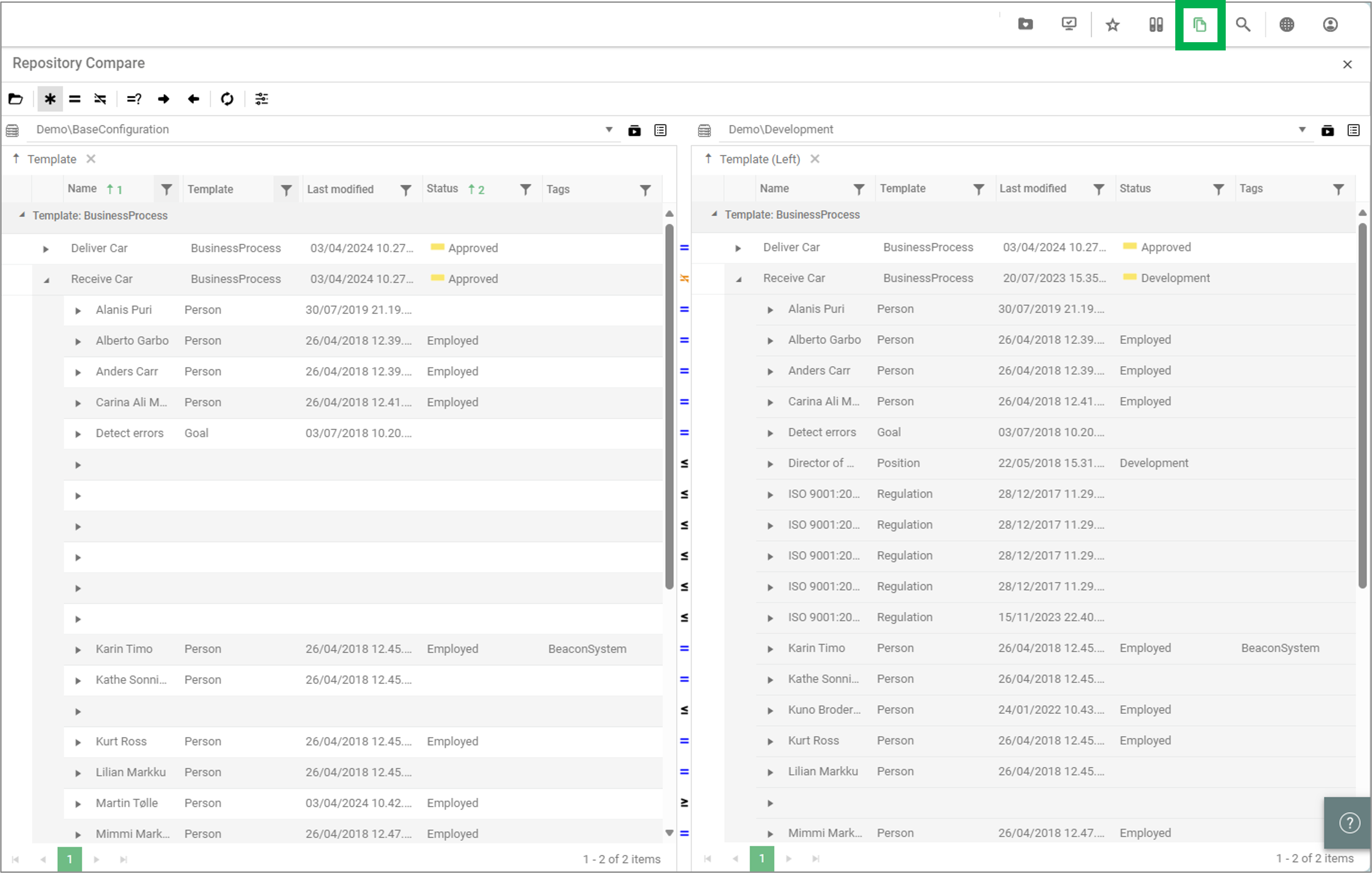
Repository Compare
The feature enables you to open a repository explorer for two different repositories at the same time, compare their content and copy content from one repository or configuration to another.
Learn more about how Repository Compare works and how you can use it.
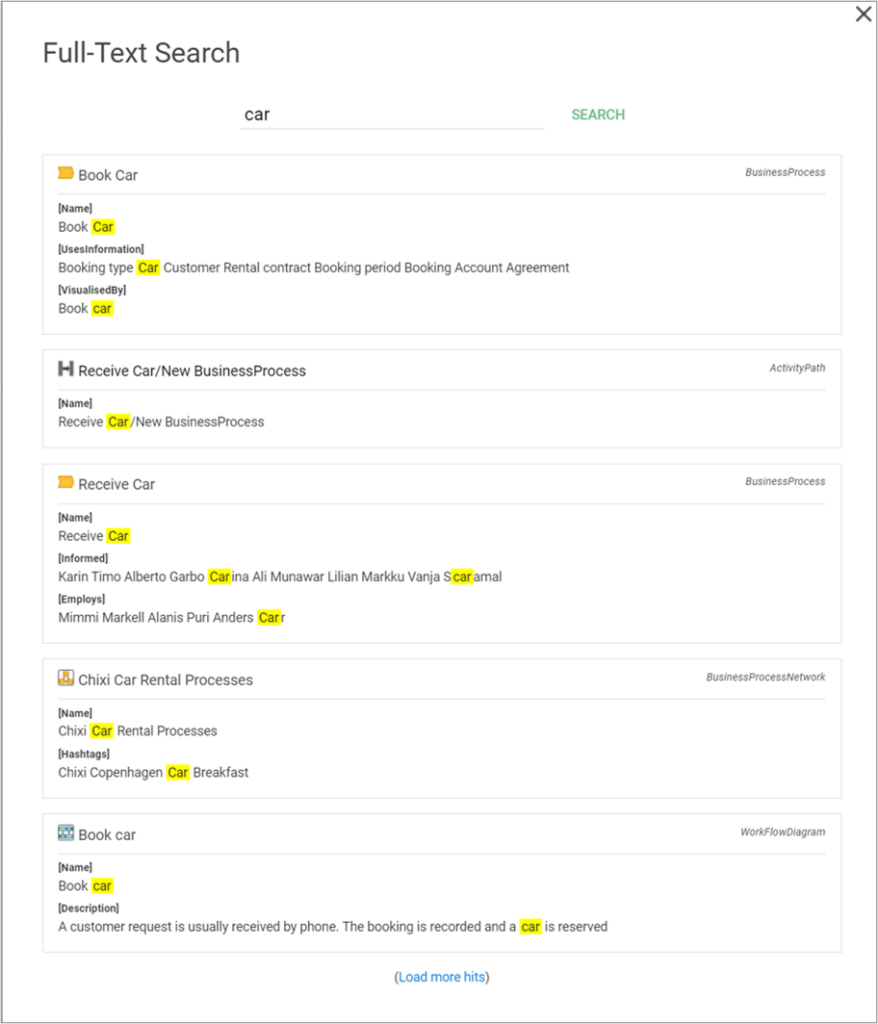
Search
The smart content search enables you to search the repository for any type of content.
Learn more about Smart Content Search, what it can do, how to use it, and how to set it up.
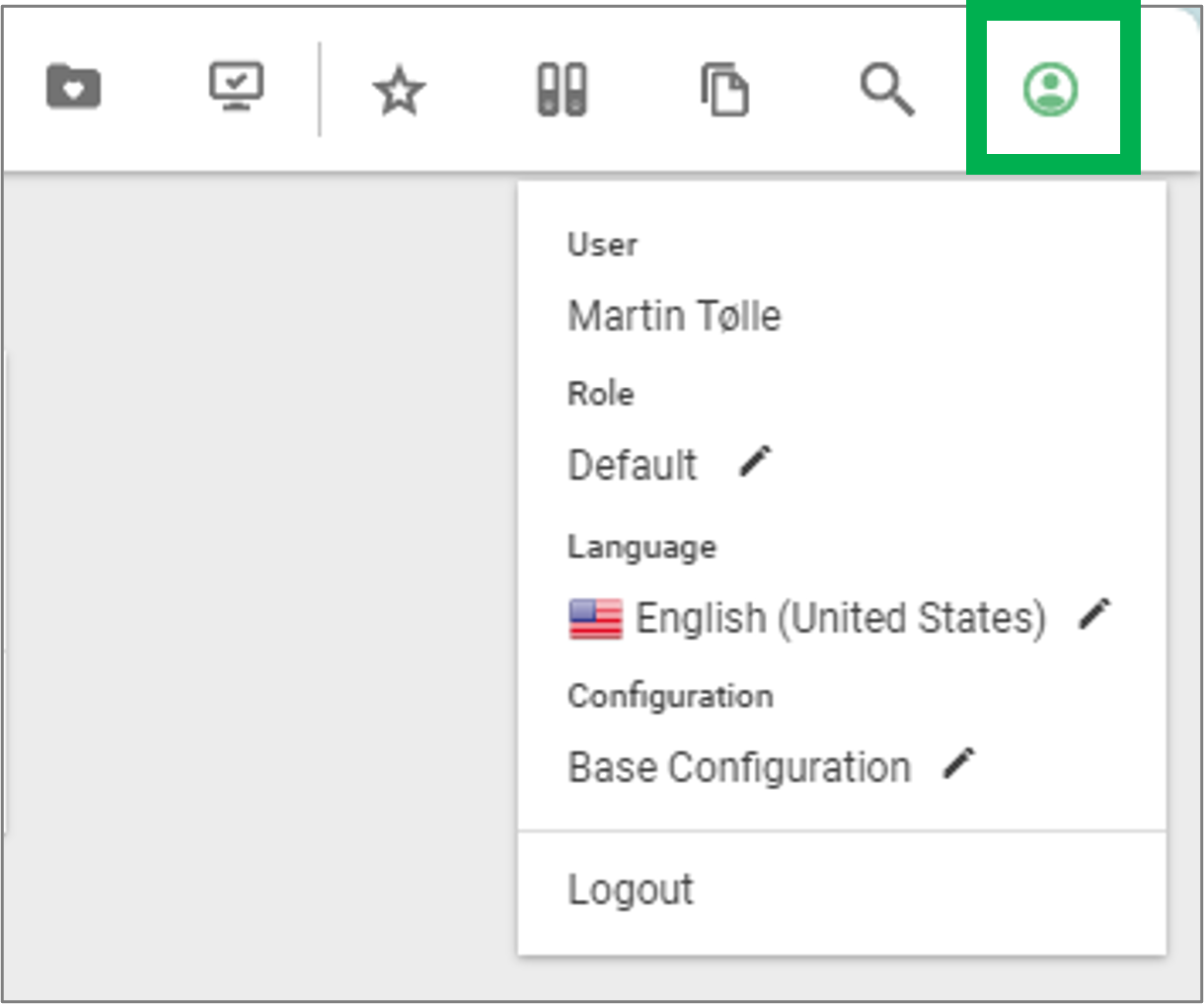
Profile
The button in the toolbar presents a drop-down menu where you can see your username and shift between roles, configurations and languages. If you remove the profile custom button from the HTMLPublisher, your profile name will appear in the left-hand side and the configuration and language buttons will be shown in the upper right-hand side. If you have the profile button and add any other custom button, they will be added to the profile drop-down menu.
QualiAI
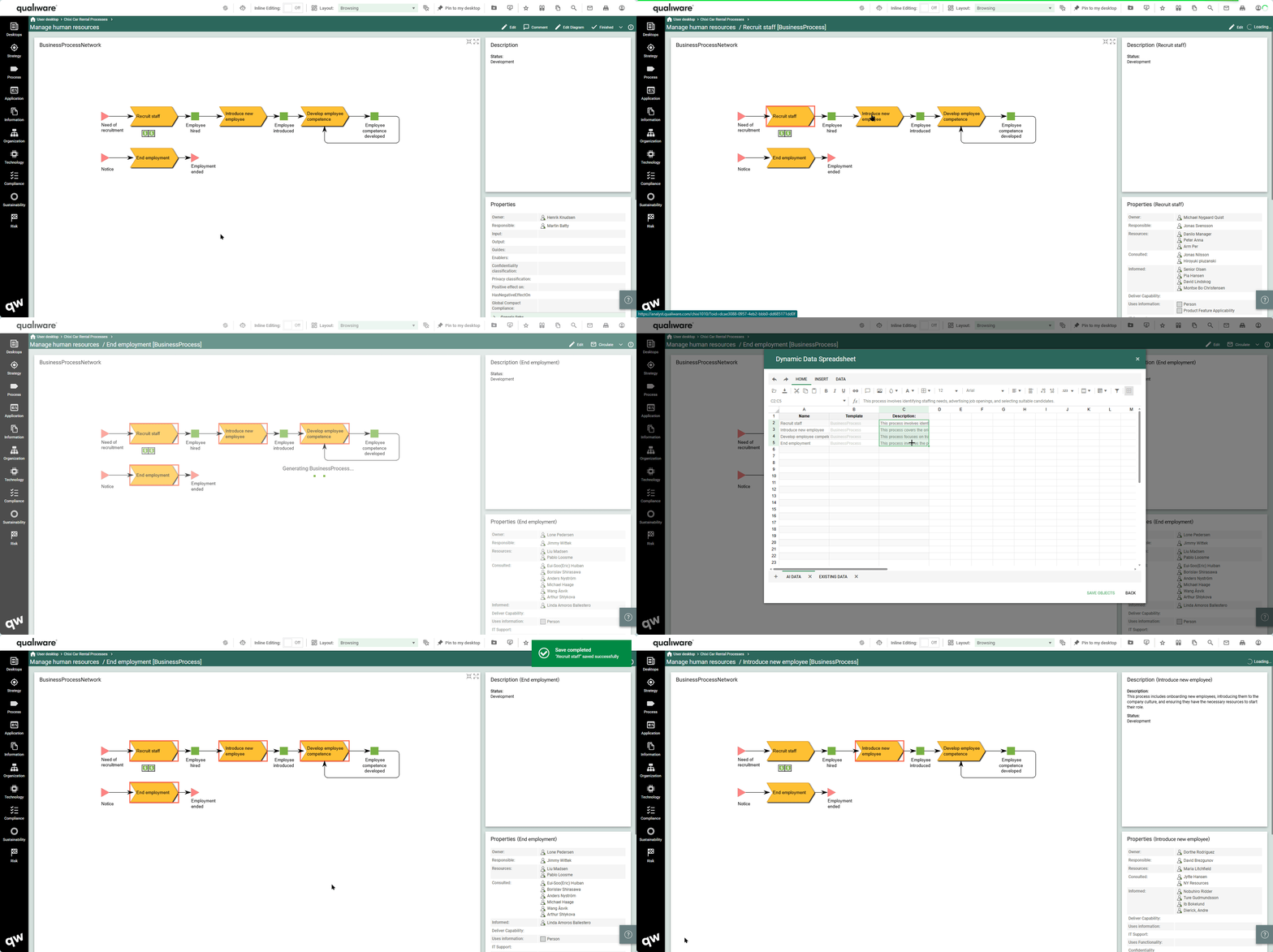
QualiAI can help you create and enrich content. This way you can easily enrich your content and get inspiration by letting the QualiAI create a diagram base upon the content and your input.
When the object(s) is selected you can add the QualiAI and prompt what you would like to get help with, and it suggestions will appear in a spreadsheet for your review and approval.
-
Outside the Web-Modeler (in the web front-end):
-
The AI button enables you to edit objects directly from a diagram view, as well as create and link new objects to those edits.
-
Example: “Add description” will create a description to the selected processes based upon the content and the process name.
-
-
Inside the Web-Modeler:
-
It analyzes context and uses KnowledgeScopes and Response Ontologies to generate diagrams where objects and their relationships are created and linked automatically.
-
Read more about QualiAI here.
QualiChat
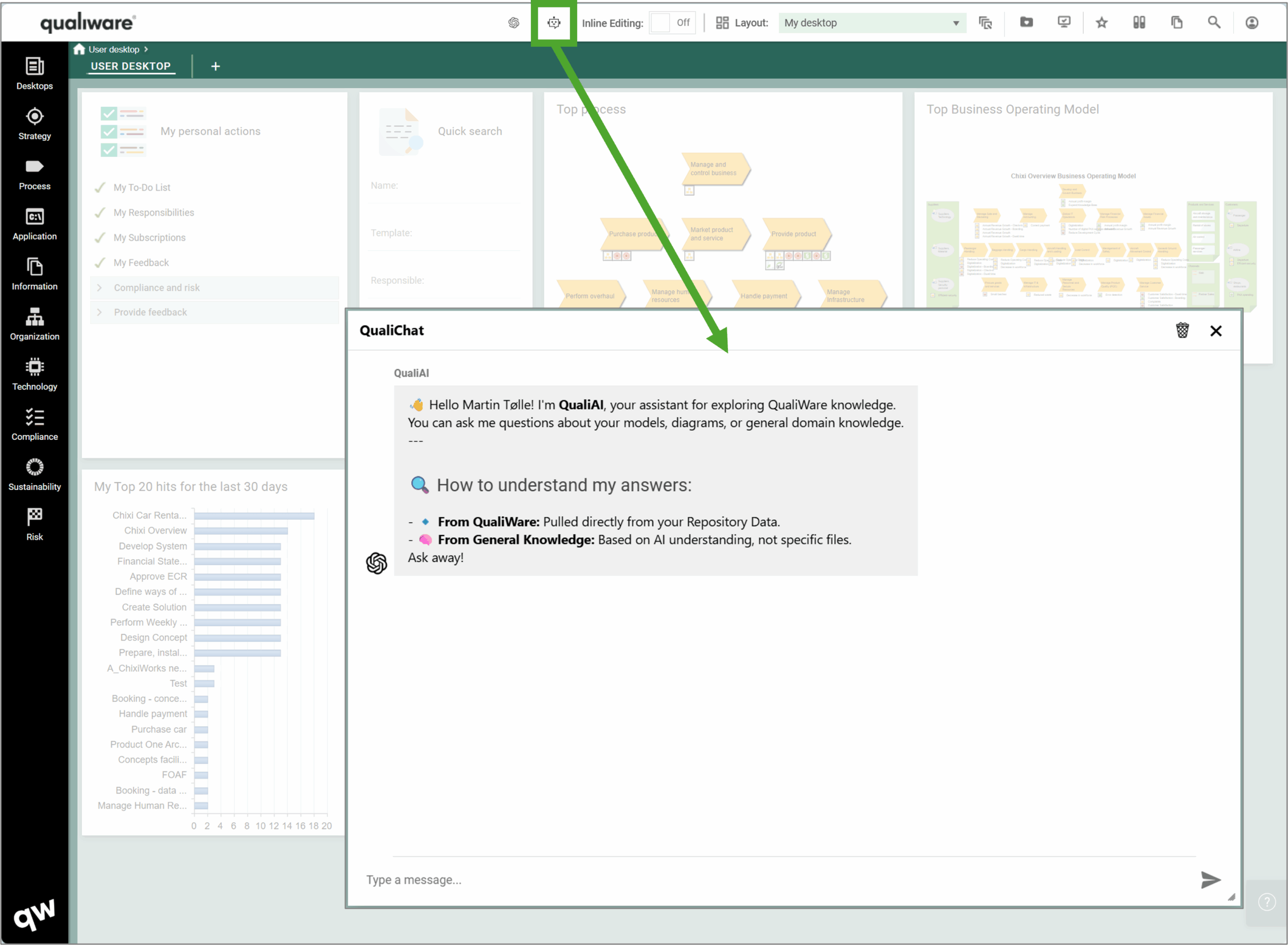
The QualiChat is an AI Chatbot that has been embedded directly in QualiWare 10.10.
This allows users to ask questions, analyze content, and explore repository data in a natural, conversational way.
Read more about QualiChat here.
QualiHelp
QualiHelp is by your side when needed. QualiHelp adapts its functionalities based on whether you are navigating the platform or are editing a diagram inside the Web-Modeler.
When your are navigating around the QualiWare platform, QualiHelp pops up asking if you need help. It acts as a static hub, providing quick access to a broad spectrum of QualiWare resources. This includes direct links to Getting Started guides, presentation of key features, latest release notes, a powerful search bar and other relevant content.
Inside the Web-Modeler, QualiHelp focuses on providing real-time, context-sensitive assistance tailored to diagram creation and modeling activities. It dynamically responds to your actions, offering specific guidance on diagrams, symbols, and connections.
In essence, while QualiHelp inside the Web-Modeler is dynamic and contextually aware, outside it becomes a rich resource center, ensuring users have the necessary support in every aspect of their interaction with QualiWare.
Read more about QualiHelp here.

Video Highlights
Configuring the Workspace
All workspace content can be configured, for the organization and the different user roles:
- Available desktops and content (tiles) on the desktop(s) (using the HTMLDesktops and HTMLDashboard)
- Look and feel for the different template types. For instance, it is possible to add information to both the right and the left side of template definitions (the view you have when you, for example, look at a diagram), or use the HTMLDashboards for the Dashboards view of a diagram.
- Content in the leftmenu (use the HTMLMegaMenu, to configure it)
The look and feel of the collaboration platform can be configured via the HTMLPublisher.
Read more about configuring the web here.